All
-
Inside the 2026 Maternal Mental Health State Report Cards: No More Overall ‘F’s, But a Brand New Failing Grade for U.S. Parental Support
Last week, the Policy Center for Maternal Mental Health, in collaboration with the George Washington University Milken Institute School of Public Health, released the much-anticipated 2026 Maternal Mental Health State Report Cards. One in five mothers experience maternal mental health conditions in the United States. The financial toll of untreated disorders is estimated to cost…
-
New Federal Medicaid Work Reporting Rule Threatens Coverage for Vulnerable Americans
Statement by Joan Alker, Executive Director of the Georgetown University Center for Children and Families and Research Professor at the McCourt School of Public Policy: “This rule gives states a raw deal, but more importantly, puts health care at risk for people with illnesses and chronic conditions like cancer or a substance use disorder. It…
-
Uninsurance Among Youngest Children on the Rise as Families Face Growing Economic Pressure
Today we released a report sharing the alarming news that the number of infants, toddlers and preschool-aged children going without insurance is now at the highest rate in nearly a decade and is rising sharply. Not only did 220,000+ more young children (birth up to age 6) become uninsured between 2022 and 2024 –they lost…
-
Uninsured Rate for Young Children Rose More Sharply than for Older Children from 2022-2024
Key Findings The number of infants, toddlers and preschoolers who are uninsured is at the highest level in nearly a decade and is increasing more sharply than for older children. The number of uninsured children under age 6 grew by 23% between 2022 and 2024, while the number of uninsured school-aged children grew by 17%. The charts and appendix…
-
Two Million Fewer Children are Enrolled in Medicaid Since Trump Took Office
Child uninsured rate likely on the rise Our state-by-state Medicaid/CHIP enrollment tracker now indicates that 2 million fewer children were enrolled in Medicaid and the Children’s Health Insurance Program (CHIP) as of April 2026, as compared to January 2025 when President Trump took office. That steep drop in the number of children enrolled in Medicaid…
-
CMS Triples Harmful Impact of HR 1 Medicaid Provider Cuts in State Directed Payment Proposed Rule
Massive Overreach will Undermine Access to Health Care for People Covered by Medicaid Last week, on May 20, 2026, the Centers for Medicare and Medicaid Services (CMS) released a proposed regulation on state-directed payments (SDP). SDPs are a mechanism for states to improve managed care payments to providers (some previous background is here). Using SDPs,…
-
From Temporary Fixes to Lasting Change: Fixing CHIP Eligibility in Kansas
By Heather Braum, Kansas Action for Children The Kansas State Legislature’s 2026 session proved successful for one particular policy: updating state law to ensure more eligible Kansas kids can access health coverage through the Children’s Health Insurance Program (CHIP). To understand why a small change will make a big impact on Kansas families – picture…
-
Medicaid Managed Care: The Big Five in Q1 2026
The “Big Five” have reported their financial and enrollment results for the first calendar quarter of 2026. The “Big Five” are the five largest publicly-traded insurers, measured by enrollment, in the Medicaid managed care market. Four of them—United Health Group, Elevance, CVSHealth/Aetna, and Centene, in that order—were also the four largest commercial health insurers by…
-
Protecting Maternal Heart Health and Lives: Key Takeaways from the New NASEM Report
As Say Ahhh! Health Policy Blog readers know, the US rates for maternal mortality and pregnancy-related mortality and severe morbidity are high, with Black and Indigenous women experiencing the highest rates. In 2024, the maternal mortality rate for Black mothers was 44.8 deaths per 100,000 live births, which was significantly higher than the rates for…
-
Protected: Driving the Conversation with Compelling Op-Eds
There is no excerpt because this is a protected post.
-
-
CMS Weaponizes Fraud Against Medicaid in California
For the second time in the 60-year history of the Medicaid program, a CMS deferral of federal matching funds has been announced by the Vice President of the United States at a White House press conference. The first time was on February 25, when Vice President J.D. Vance told the press that CMS was delaying…
-
When Grief Becomes a Crime in Texas: Black Maternal Mental Health and Care Gaps We Cannot Ignore
By Tanesha Mondestin and Kay Matthews A Mother’s Pain, A System’s Failure In February 2026, Tamisha Cheyniece Drake of Lufkin, Texas, lost her newborn daughter at birth. Two months later, she returned to the cemetery where her baby had been buried, dug up the grave, and removed her daughter’s remains. She was arrested and charged…
-
CMS Weaponizes Fraud Against Medicaid in Minnesota: Is the Fiscal Assault Headed for the Off-Ramp?
The fiscal assault on Minnesota’s Medicaid program appears to be headed for the off-ramps. Led by Dr. Mehmet Oz, the CMS Administrator, with the full-throated support of Vice President J.D. Vance, CMS launched a two-pronged attack. The first, launched on January 6, was a threat to withhold $515 million in federal Medicaid matching funds per…
-
The New Medicaid Work Reporting Requirements Are Here—Don’t Let the Nebraska “Soft Start” Fool You
On May 1, 2026, Nebraska became the first state to start the new work requirements under H.R. 1, the law passed last year making historic cuts to Medicaid. We have reported extensively on why work reporting requirements are a bad idea. Nebraska was not adequately prepared to launch work reporting requirements, nor has the Centers…
-
Meeting Families Where They Are: How Medicaid Can Strengthen Children’s Health Through Community Health Workers
When a child misses a well-child visit, falls behind on immunizations, or goes undiagnosed with a chronic condition, the consequences can ripple across a lifetime. Children whose health needs are addressed early are more likely to thrive academically, economically, and physically as adults. Yet for families navigating delays to care amid fragmented health and social…
-
Drop in Child Medicaid and CHIP Enrollment Even Before HR 1 Policies Take Full Effect is Troubling Sign
The drop in Medicaid/CHIP enrollment means more children are likely becoming uninsured. We spend a lot of our time at the Georgetown University Center for Children and Families monitoring child and adult Medicaid and the Children’s Health Insurance Program (CHIP) health coverage trends. The latest federal CMS data confirms that child enrollment in these programs…
-
What Do We Know So Far About State Materials & Consumer Outreach on Medicaid Work Reporting Requirements?
States need to do effective, consumer-friendly outreach and education to communicate new work reporting requirements to affected Medicaid expansion adults and new applicants. Mandatory work reporting is one of the biggest seismic shifts in Medicaid policy in a generation, and without strong outreach and public awareness – including through content that is easy to understand…
-
New Report Shows How States Can Leverage School Medicaid Programs to Protect K-12 Education Funding
A new report from the Urban Institute details the difficult situation state lawmakers and executive leaders will face as they grapple with the loss of federal funding due to HR 1, also known as the “One Big Beautiful Bill Act,” that was signed into law July 4, 2025. While the law did not directly cut…
-
2026 Report on State Medicaid and CHIP Eligibility, Enrollment, and Renewal Policies Includes Special Edition on Medicaid Work Requirements
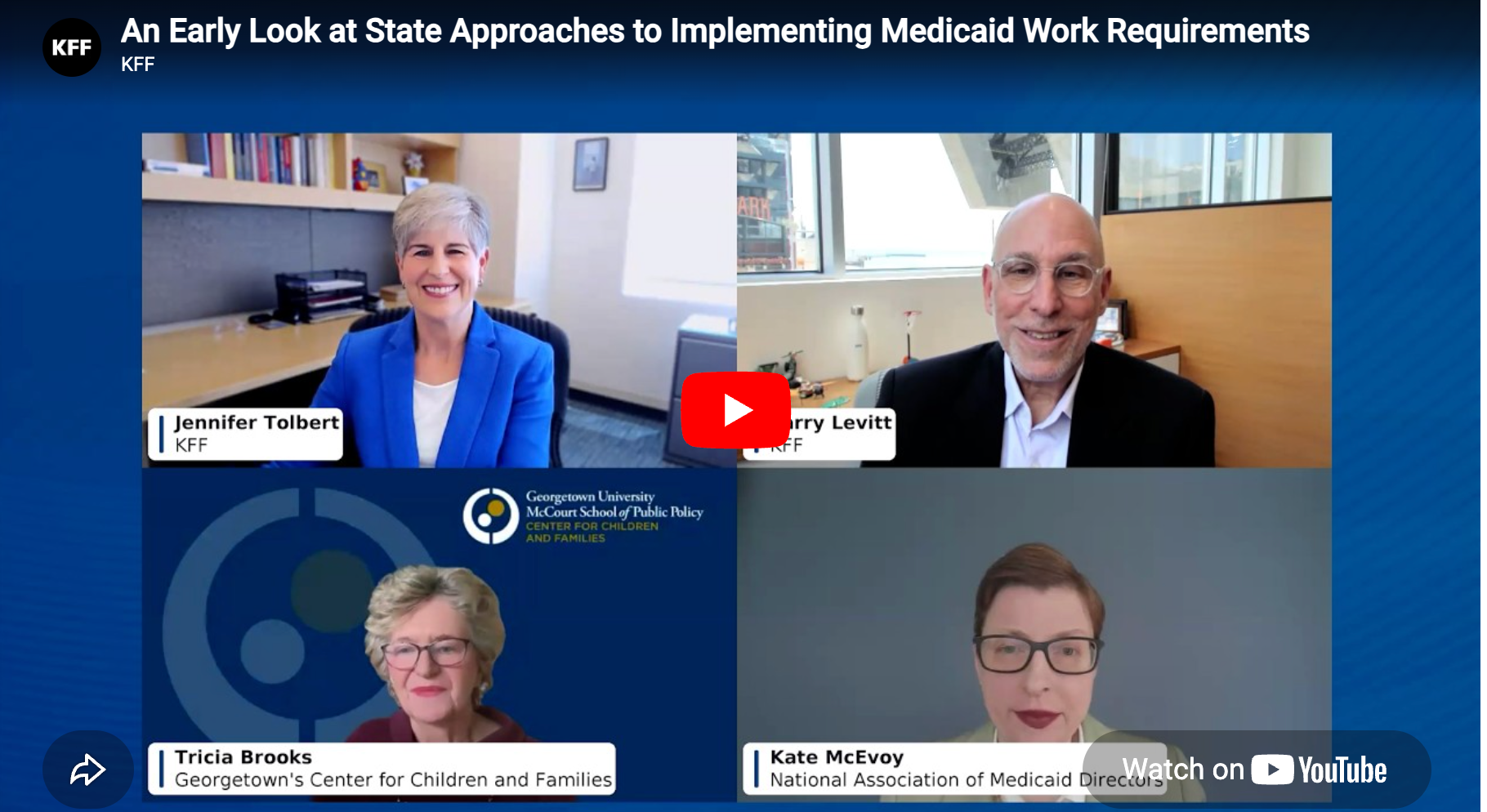
Yesterday, the annual KFF survey report was released with a webinar featuring highlights of two reports and a discussion that included Kate McEvoy, executive director of the National Association of Medicaid Directors, and was moderated by KFF’s Larry Levitt. The webinar and reports contain important information that should be of interest to policymakers, stakeholders, members…