National
-
Inside the 2026 Maternal Mental Health State Report Cards: No More Overall ‘F’s, But a Brand New Failing Grade for U.S. Parental Support
Last week, the Policy Center for Maternal Mental Health, in collaboration with the George Washington University Milken Institute School of Public Health, released the much-anticipated 2026 Maternal Mental Health State Report Cards. One in five mothers experience maternal mental health conditions in the United States. The financial toll of untreated disorders is estimated to cost…
-
Tracking Implementation of H.R. 1 Medicaid Work Reporting Requirements
The 2025 budget reconciliation bill (H.R. 1) requires states to implement work reporting requirements (WRRs) for Medicaid expansion adults, as well as adults covered by partial adult waiver expansions in Georgia and Wisconsin, starting in 2027. In 43 states including the District of Columbia, unless they are exempt, expansion adults must complete and report at…
-
The White House Task Force to Eliminate Fraud: What’s at Stake for Medicaid
On March 19, President Trump issued an Executive Order Establishing the Task Force to Eliminate Fraud. The stated purpose of the Task Force, which is chaired by Vice President J.D. Vance, is to “coordinate and accelerate a comprehensive national strategy to stop fraud, waste, and abuse within Federal benefit programs, including programs administered jointely with…
-
Medicaid’s Role in Small Towns and Rural Areas
Key Findings Background One-fifth of people in the United States live in areas that are classified as non-urban. Residents of rural areas and small towns face additional challenges accessing needed health services compared to residents of metro areas for a variety of reasons including acute provider shortages, limited connectivity, and long distances to travel to…
-
State Medicaid and CHIP Snapshots, 2023
The Georgetown University Center for Children and Families (CCF) and the American Academy of Pediatrics (AAP) created factsheets underscoring the importance of Medicaid in providing coverage for children in all 50 states and the District of Columbia. Sources available here. Previous snapshots can be found here (2019), here (2018) and here (2017). Check out more interactive…
-
School Reopening Debate Highlights Student Health Concerns
The political debate over reopening schools has brought children’s health to the forefront of the nation’s coronavirus crisis, often in ways contrary to expectations. Conservative leaders, pushing for in-person instruction, are citing the social-emotional needs of children stuck at home for months. Liberal leaders, urging caution, are calling for local control of schools. From a…
-
Pediatricians and CCF Release 2019 State Snapshots on Children’s Health Coverage
We’ve continued the tradition we started three years ago with our colleagues at the American Academy of Pediatrics to create state snapshots that focus on the valuable role Medicaid and CHIP fill for children. These snapshots provide details on who’s covered by Medicaid and CHIP in each state and how Medicaid/CHIP fit into the overall…
-
Hot Off the Press: Annual KFF 50-State Survey on Medicaid
This 17th annual KFF survey and key resource for Medicaid stakeholders reports eligibility, enrollment, renewal and cost-sharing policies in place as of January 2019 for children, pregnant women, parent/caretakers, and low-income adults in Medicaid and CHIP. Like the previous year, for the most part states continued to refine their efforts in delivering a streamlined, data-driven…
-
The Kentucky Medicaid Waiver Approval: How Do You Spell “Arbitrary and Capricious”?
Late last Friday, a federal District Court overturned the approval of the Kentucky HEALTH waiver by the Secretary of HHS and sent it back to the agency. As a result, Kentucky could not implement work requirements or other harmful changes – premiums, lockouts, elimination of retroactive coverage, etc. – on July 1, as it had…
-
Snapshot of Children’s Coverage by Race and Ethnicity
Medicaid and the Children’s Health Insurance Program (CHIP) are primary sources of health coverage for children. These programs are particularly important to children of color, who are disproportionately represented among beneficiaries because they are more likely to be economically disadvantaged. Read and download our snapshots Snapshot of Children with Medicaid by Race and Ethnicity, 2018…
-
Kaiser 50-State Survey on Medicaid/CHIP Eligibility, Enrollment, Renewal and Cost-Sharing Policies Released
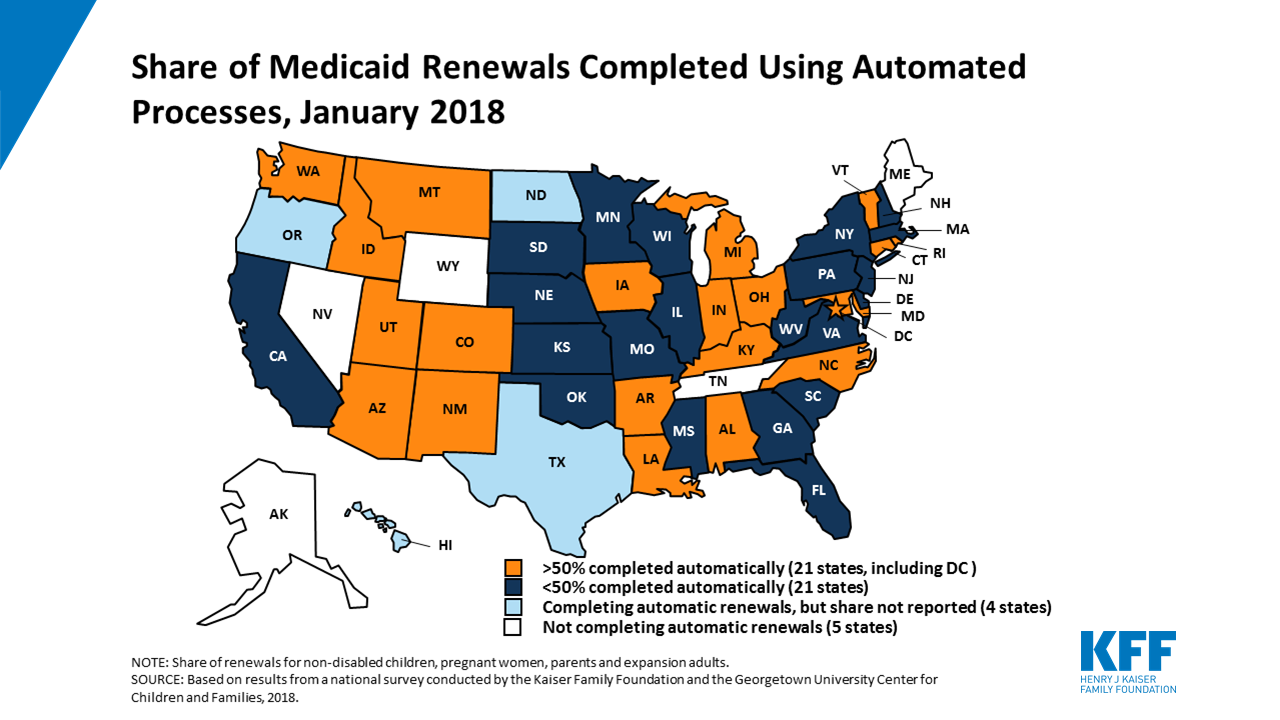
The Kaiser Family Foundation teamed up with Georgetown University Center for Children and Families researchers for the eighth year to conduct the annual 50-State Survey on Medicaid and CHIP. This 16th annual report reflects eligibility, enrollment, renewal, and cost-sharing policies in place as of January 2018. This year’s report takes stock of how the programs have…
-
Kaiser Family Foundation 50-State Budget Survey Provides Insight Into Medicaid Trends
The Kaiser Family Foundation’s annual 50-state budget survey is here! This year, they’ve captured the findings in three reports – Medicaid Enrollment & Spending Growth: FY 2017 & 2018, providing an analysis of national trends in Medicaid enrollment and spending; Medicaid Moving Ahead in Uncertain Times, taking a more detailed look at the policy and…
-
It’s Not Time to Give Away Consumer Protections for Cost-Sharing Reduction Reimbursements
A whirlwind of activity following the White House announcement that cost-sharing reduction (CSR) reimbursements would no longer be made has culminated, at least for now, in a bipartisan agreement in the Senate to appropriate the payments for two years. While the legislation negotiated by Senators Alexander and Murray had 24 co-sponsors as of October 19, it is unclear…
-
Nationwide Rate of Uninsured Children Reaches Historic Low
Nationwide 95.5 percent of children had health insurance in 2016, up from 95.2 percent the previous year—and up from 92.9 percent in 2013, the year before the ACA was fully implemented. While relatively few children rely on the ACA’s Marketplace for insurance, many gained coverage in Medicaid or CHIP when their parents signed up for…
-
States Scramble to Overcome Congress’ Failure to Move on CHIP
Stateline By Michael Ollove With the U.S. Senate distracted last month by another Hail Mary attempt by Republicans to repeal and replace the Affordable Care Act, Congress didn’t get around to reauthorizing CHIP by the Sept. 30 deadline. And that has left states contemplating how to keep the program running when the federal funding runs…
-
Health care reform efforts complicate CHIP extension
Special Education Connection Efforts in Congress to renew the Children’s Health Insurance Program have begun to steer off course as some lawmakers want to attach other health care reform proposals to the CHIP legislation. … “If we can’t extend CHIP, it will put undue stress on kids and families and that will have a ripple…
-
Pay for health coverage for kids? Not so fast | Editorial
There’s no more glaring example of this basic failure of governance than the expiration this past weekend of federal funding of the Children’s Health Insurance Program and other critical safety-net programs that provide services to hundreds of thousands of Pennsylvanians and millions more people nationwide. … In Pennsylvania, 176,241 children receive services through CHIP, a joint federal…
-
The Medicaid Expansion is Good for Parents AND Good for Children
Parents and children are more likely to have health coverage now than they were before the Affordable Care Act took effect. The Urban Institute released new research that shows the rate of insurance coverage for parents and children increased significantly between June/September 2013 and March 2017. During the time period, the rate of coverage increased…
-
Who Are the Uninsured Adults?
Last week we posted a piece about the shrinking pool of uninsured adults, based on a Health Affairs study showing that the rate of adults without insurance dropped from 16 percent to 7 percent in states that took the Affordable Care Act’s Medicaid expansion. Hidden at the end of this Health Affairs study, is a…
-
States Say They Will Run Out of CHIP Funds Faster than Projected; Will Congress Act in Time?
Ten states project they will run out of CHIP funds before the end of 2017 according to a new brief released by the Kaiser Family Foundation (KFF), based on responses from 42 states during the KFF’s annual Medicaid budget survey. The ten states are: Arizona, California, Connecticut, Hawaii, Idaho, Mississippi, Nevada, Oregon, Pennsylvania and Utah.…