Minnesota
-
State Medicaid and CHIP Snapshots, 2023
The Georgetown University Center for Children and Families (CCF) and the American Academy of Pediatrics (AAP) created factsheets underscoring the importance of Medicaid in providing coverage for children in all 50 states and the District of Columbia. Sources available here. Previous snapshots can be found here (2019), here (2018) and here (2017). Check out more interactive…
-
The Proper Use of Medicaid Improper Payment Rates
For the first time, CMS has posted state-specific rates of improper payments in Medicaid. This welcome exercise in transparency is a sea change in the Payment Error Rate Measurement (PERM) program, which CMS has been using since 2007 to help states improve the accuracy of their Medicaid payments. Until now, CMS has been reporting only…
-
2016 Maps
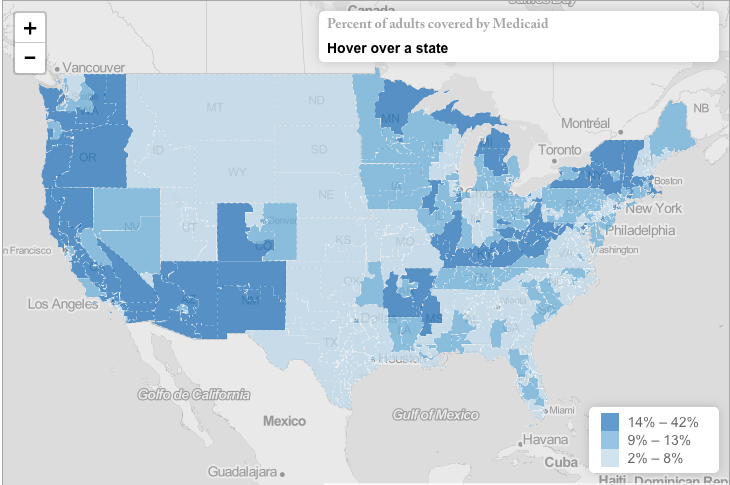
The interactive maps and data for 2016 provide information on the percent of adults and children covered by Medicaid and/or CHIP.You can embed these maps on your website by selecting a state on the left then copying the embed code on the right side of the map and pasting it into a post on your…
-
Nation’s Progress on Children’s Health Coverage Reverses Course
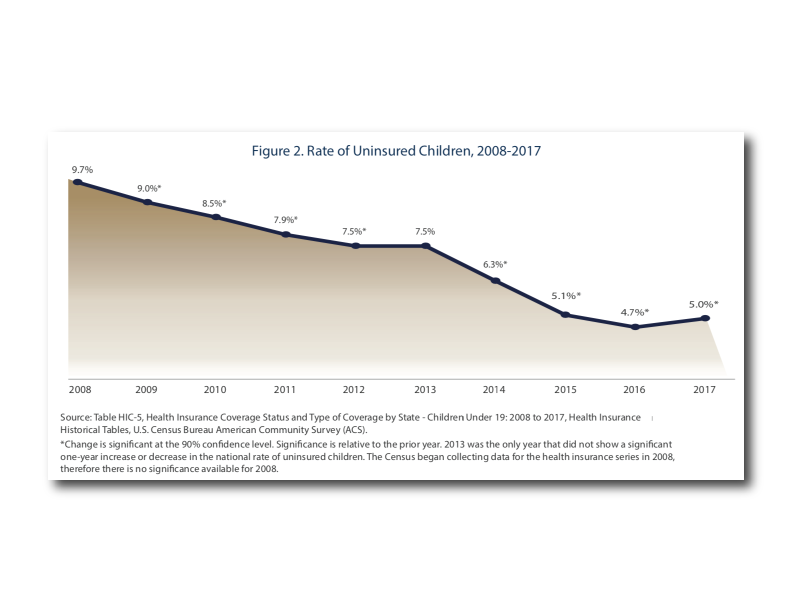
Introduction For the first time since comparable data was first collected in 2008, the nation’s steady progress in reducing the number of children without health insurance reversed course. The number of uninsured children under age 19 nationwide increased by an estimated 276,000 to about 3.9 million (3,925,000) in 2017, according to newly-available data from the…
-
Uninsured Numbers Drop in Rural MN with Medicaid Expansion
Public News Service By: Roz Brown Since Minnesota expanded its Medicaid program in 2013, the number of people uninsured in the state’s rural areas has been cut nearly in half. A new report from the Georgetown University Center for Children and Families examines how states are doing, whether or not they opted to expand Medicaid,…
-
State Medicaid and CHIP Snapshots, 2018
The Georgetown University Center for Children and Families (CCF) and the American Academy of Pediatrics (AAP) created factsheets underscoring the importance of Medicaid in providing coverage for children in all 51 states (including the District of Columbia). Sources are available here. Previous snapshots can be found here.
-
Nationwide Rate of Uninsured Children Reaches Historic Low
Nationwide 95.5 percent of children had health insurance in 2016, up from 95.2 percent the previous year—and up from 92.9 percent in 2013, the year before the ACA was fully implemented. While relatively few children rely on the ACA’s Marketplace for insurance, many gained coverage in Medicaid or CHIP when their parents signed up for…
-
Section 1115 Medicaid Waiver Comments
Georgetown University’s Center for Children and Families contributes an independent perspective to the public dialogue on the future of Medicaid through the lens of children and their families.
-
State CHIP Snapshots
The Role of CHIP in Children’s Coverage In 2016 the children’s health insurance coverage rate in the United States dropped to just above 95 percent, an impressive achievement. Key to this success is the Children’s Health Insurance Program, which provides coverage to children who do not qualify for Medicaid but whose families cannot otherwise afford…
-
INTERACTIVE MAPS: Children Covered by Medicaid and CHIP by county, state or congressional district.
These maps show how many children are covered by Medicaid in each county and congressional district. Visit these links to view the maps, and to download handouts on your state’s coverage data: Percent of Children Covered by Medicaid/CHIP (congressional district) Percent of Children Covered by Medicaid/CHIP (county) Visit CCF’s State Resource Center for state-level data on health…
-
CLASP ED Olivia Golden Invites Children’s Advocates to Help Combat Maternal Depression
Olivia Golden, the Executive Director of the Center for Law and Social Policy (CLASP), joined this month’s CCF state partner call to share her extensive knowledge about maternal depression. She gave an impassioned call to action for children’s advocates to work on policies to address maternal depression and made the following key points. Maternal depression…
-
Understanding ACA’s Coverage Gains: Welcome Mat Effect & State Marketplaces Keys to Success
By Molly Frean and Benjamin D. Sommers, Harvard T.H. Chan School of Public Health & Jonathan Gruber, Massachusetts Institute of Technology One of the primary goals of the Affordable Care Act (ACA) was to reduce the number of individuals without health insurance in the United States. Prior to the passage of the legislation, this group…
-
Two States On the Path to the Basic Health Program
Both Minnesota and New York are on the path to setting up a Basic Health Program (BHP) that will provide more affordable coverage for low-income families than they may find on the marketplace. Minnesota passed BHP legislation that was signed into law in May 2013. In New York, BHP was included in the Governor’s budget…
-
Children’s Coverage on the Eve of the Affordable Care Act
Here’s a good news story on health coverage that the public is largely unaware of. The number of uninsured children continues to decline to historic lows – a remarkable accomplishment given the high childhood poverty rate and tough economic times. Yet a majority of Americans are unaware of this achievement. In a poll CCF commissioned…
-
Children’s Health Coverage on the Eve of the Affordable Care Act
Georgetown University Center for Children and Families researchers analyzed health insurance data from the Census Bureau’s annual American Community Survey to get a closer look at children’s coverage trends. On the eve of the implementation of the Affordable Care Act coverage expansions, the authors found important lessons from the success the U.S. has had in covering children. The number of uninsured…
-
What Can States Do to Ensure Insurers Don’t Limit Consumer Choice?
This morning, the New York Times ran a front page story headlined: “Lower Premiums to Come at Cost of Fewer Choices“. While I feel for the editors that have to explain such a complex topic in half the characters of a tweet, that headline will certainly trigger a chorus of “I told you so’s” from…
-
Getting Into Gear for 2014: Findings from a 50-State Survey of Eligibility, Enrollment, Renewal, and Cost-Sharing Policies in Medicaid and CHIP, 2012-2013
As 2013 begins, implementation of the major provisions of the ACA, including its coverage expansions, is less than a year away. Following the Supreme Court ruling to uphold the ACA and the 2012 elections, efforts to prepare for 2014 are moving into high gear in many states. The majority of states are capitalizing on web-based…
-
Uninsured Children 2009-2011: Charting the Nation’s Progress
Georgetown University Center for Children and Families researchers analyzed health insurance data from the Census Bureau’s annual American Community Survey to get a closer look at children’s coverage trends. The authors found that the nation continues to make steady progress covering children, despite no reduction in the number of children living in poverty. A strong commitment to…
-
State Fact Sheets Highlight Importance of Medicaid Coverage for Children
By Ielnaz Kashefipour, American Academy of Pediatrics The American Academy of Pediatrics, in partnership with the Children’s Hospitals Association (formerly NACHRI), this week produced updated state-by-state fact sheets that explain the importance of the Medicaid program for children. These fact sheets are used in federal and state advocacy efforts to protect the Medicaid program from…
-
Lack of Dental Care Poses Health Risk to Children
By Tara Mancini Dental cavities are the most prevalent chronic disease among children. Many children are not able to obtain the dental care they need due to cost barriers, a shortage of dental health professionals in their area or for other reasons. According to an Institute of Medicine (IOM) report, as many as 4.6 million…