2005
-
Center for Children and Families Launches
Washington, D.C. – Amid high-profile debate on the future of Medicaid, the new Center for Children and Families (CCF) launched today. CCF is uniquely focused on developing and disseminating research, strategies and ideas to improve the health of America’s low- and moderate income children and families. Read the Full Release
-
In January 2014, eligibility levels for parents and childless adults will significantly increase
In January 2014, eligibility levels for parents and childless adults will significantly increase in the 26 states, including DC, that are expanding Medicaid to adults. (Source: New! Getting Into Gear for 2014)
-
Jocelyn Guyer aca affordable coverage
“Children thrive when their parents are healthy and insured. The Affordable Care Act will offer more affordable coverage to parents and other adults along the income scale.”
-
Joan Alker 3 Stable src of health care coverage
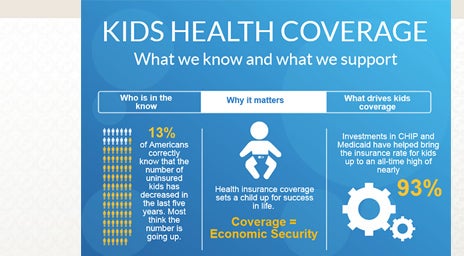
“CHIP and Medicaid have been a stable source of health care coverage for America’s children and together they have brought the uninsured rate for children to a historic low.”
-
Joan Alker 2 ER trips
“Preventive care keeps children healthy and more likely to avoid expensive trips to the ER for treatable conditions like asthma.”
-
Joan Alker
“More than half of America’s children gained or maintained access to preventive care services as a result of the Affordable Care Act.”
-
More Children Covered Thanks to Medicaid/CHIP
The number of uninsured children continued to decline in 2012. Although children are covered at much higher rates than most adults, they still lag behind seniors. Read CCF’s 50-state analysis “Children’s Health Coverage on the Eve of the Affordable Care Act” by clicking above.
-
The New TennCare Waiver Proposal: What Is The Impact On Children?
This issue brief discusses the TennCare program and proposed amendments, submitted to the federal government in September 2004 and February 2005, to the state’s Section 1115 Medicaid waiver. It shows that although many of the proposed restrictions in benefits and cuts in eligibility explicitly apply to adults and not to children, the state also seeks…
-
Issues to Consider in Governor Bush’s “Florida Medicaid Modernization Proposal”
This issue brief discusses Florida Governor’s Medicaid Modernization Proposal (released in January 2005), describing how the plan envisions that Medicaid costs will be reduced, how the new system will work, and what it will mean for beneficiaries and providers.
-
New Developments in Medicaid Coverage: Who Bears Financial Risk and Responsibility?
This issue brief provides an overview of federal Medicaid waiver activity and reviews the implications for coverage and access to care. It explores how waivers give states federal approval to alter the way they provide coverage and/or deliver services to low-income populations.
-
Financing Health Coverage: The State Children’s Health Insurance Program Experience
Despite SCHIP’s success in covering children, the program’s financing structure has been fraught with problems necessitating frequent revisions in the law and ongoing debate about how to address these problems. Financing issues have caused inequities and uncertainties across states, as well as projections that, in some states, children could lose coverage over the next few…
-
The President’s Proposals For Medicaid and SCHIP: How Would They Affect Children’s Health Care Coverage?
On February 7, 2005, President Bush released his budget proposal for fiscal year 2006. The proposal reduces overall federal funding for Medicaid by at least $45 billion over ten years. It also anticipates, but does not spell out, policy changes that could have a major impact on children’s coverage. This issue brief analyzes the President’s…
-
Families at Risk: Impact Of Lower Eligibility Limits for Parents of Husky A Children
In April 2003, Connecticut lowered the income eligibility level for working parents from 150 percent to 100 percent of the federal poverty level. This issue brief discusses the policy’s impact throughout the state. This issue brief is part of Families at Risk, a series of policy briefs exploring the consequences of changes to the Connecticut’s…