Missouri
-
Nationwide Rate of Uninsured Children Reaches Historic Low
Nationwide 95.5 percent of children had health insurance in 2016, up from 95.2 percent the previous year—and up from 92.9 percent in 2013, the year before the ACA was fully implemented. While relatively few children rely on the ACA’s Marketplace for insurance, many gained coverage in Medicaid or CHIP when their parents signed up for…
-
Section 1115 Medicaid Waiver Comments
Georgetown University’s Center for Children and Families contributes an independent perspective to the public dialogue on the future of Medicaid through the lens of children and their families.
-
State CHIP Snapshots
The Role of CHIP in Children’s Coverage In 2016 the children’s health insurance coverage rate in the United States dropped to just above 95 percent, an impressive achievement. Key to this success is the Children’s Health Insurance Program, which provides coverage to children who do not qualify for Medicaid but whose families cannot otherwise afford…
-
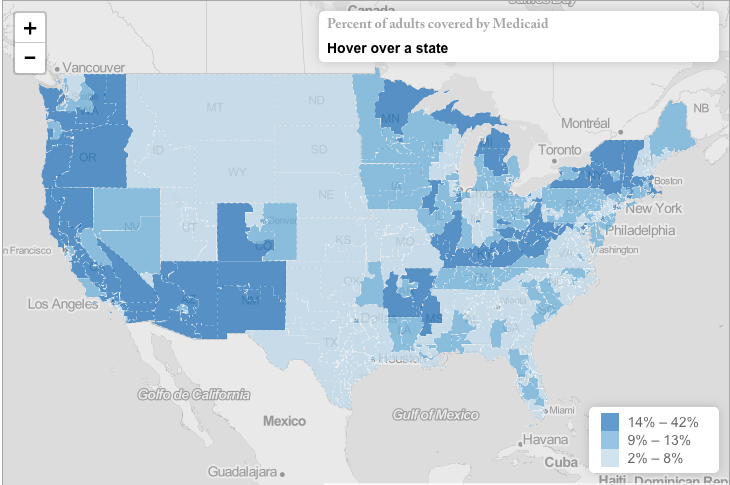
INTERACTIVE MAPS: Children Covered by Medicaid and CHIP by county, state or congressional district.
These maps show how many children are covered by Medicaid in each county and congressional district. Visit these links to view the maps, and to download handouts on your state’s coverage data: Percent of Children Covered by Medicaid/CHIP (congressional district) Percent of Children Covered by Medicaid/CHIP (county) Visit CCF’s State Resource Center for state-level data on health…
-
Report Suggests Improved Outreach and Enrollment Efforts Directed at Very Poor Parents Needed
As I was flying back from Atlanta the other night, I read a fascinating new paper by researchers at the Urban Institute (a team led by the esteemed Genevieve Kenney), which looks at adult uninsured rates and participation rates in Medicaid. In particular, the researchers examine how the number of uninsured parents and childless adults…
-
More on that HHS QHP-CHIP Comparison
My last blog before maternity leave was on the release of HHS’s certification summary, or the results of the agency’s Congressionally mandated comparison of CHIP with the qualified health plan (QHP) coverage children receive. My first blog since returning to work full time is on the same topic—in late May, HHS’s Office of the Assistant…
-
Medicaid Expansion is Having Positive Ripple Effects
(Editor’s Note: You can hear the recording of our press call releasing the report here.) By Adam Searing and Jack Hoadley The 19 states that continue to decline federal funding to offer Medicaid coverage to more uninsured residents are missing out on more than just improvements to their uninsured and uncompensated care rates. In fact,…
-
Beyond the Reduction in Uncompensated Care: Medicaid Expansion Is Having a Positive Impact on Safety Net Hospitals and Clinics
More than two years after the onset of expanded Medicaid coverage, significant differences are emerging between states that opted to expand Medicaid and those that did not. This report contains the findings of telephone interviews with eleven leaders of hospital systems and federally qualified health centers (FQHCs) in seven states. Three of the states where we conducted interviews…
-
Missouri’s Health Reform Assisters Triumph In Court
By Emily Curran, Georgetown University Center on Health Insurance Reforms Health reform advocates experienced a win last month, when a federal court in Missouri struck down three sections of a recently enacted state law that interfered with the ability of consumer assistance personnel to help Missourians understand their health insurance options and enroll in coverage.…
-
Federal Court Ruling: Navigator Laws Cannot Impose Additional Requirements on Navigators and Other Assisters in Federal Marketplace States
A federal district court ruling yesterday regarding Missouri’s navigator law has the health coverage community abuzz. As I noted in this Say Ahhh! blog, a number of states have proposed or passed legislation to require additional training and licensing for navigators, and sometimes other assisters, and restrict the activities they are required to perform by…
-
Children’s Coverage on the Eve of the Affordable Care Act
Here’s a good news story on health coverage that the public is largely unaware of. The number of uninsured children continues to decline to historic lows – a remarkable accomplishment given the high childhood poverty rate and tough economic times. Yet a majority of Americans are unaware of this achievement. In a poll CCF commissioned…
-
Children’s Health Coverage on the Eve of the Affordable Care Act
Georgetown University Center for Children and Families researchers analyzed health insurance data from the Census Bureau’s annual American Community Survey to get a closer look at children’s coverage trends. On the eve of the implementation of the Affordable Care Act coverage expansions, the authors found important lessons from the success the U.S. has had in covering children. The number of uninsured…
-
Getting Into Gear for 2014: Findings from a 50-State Survey of Eligibility, Enrollment, Renewal, and Cost-Sharing Policies in Medicaid and CHIP, 2012-2013
As 2013 begins, implementation of the major provisions of the ACA, including its coverage expansions, is less than a year away. Following the Supreme Court ruling to uphold the ACA and the 2012 elections, efforts to prepare for 2014 are moving into high gear in many states. The majority of states are capitalizing on web-based…
-
Affordable Care Act’s Ban on Lifetime Limits Has Ended Martin Addie’s Coverage Circus
By Joanne Volk, Center on Health Insurance Reforms What would you do if you had a health care condition that required regular, costly care your whole lifetime? You’d probably be sure you had uninterrupted health coverage so you could get the care you need without bankrupting your family. For tens of millions of Americans like…
-
Uninsured Children 2009-2011: Charting the Nation’s Progress
Georgetown University Center for Children and Families researchers analyzed health insurance data from the Census Bureau’s annual American Community Survey to get a closer look at children’s coverage trends. The authors found that the nation continues to make steady progress covering children, despite no reduction in the number of children living in poverty. A strong commitment to…
-
State Fact Sheets Highlight Importance of Medicaid Coverage for Children
By Ielnaz Kashefipour, American Academy of Pediatrics The American Academy of Pediatrics, in partnership with the Children’s Hospitals Association (formerly NACHRI), this week produced updated state-by-state fact sheets that explain the importance of the Medicaid program for children. These fact sheets are used in federal and state advocacy efforts to protect the Medicaid program from…
-
Medicaid Coverage for Parents under the Affordable Care Act – State Fact Sheets
This issue brief presents national estimates of the number and characteristics of uninsured parents who would be eligible for Medicaid in 2014 according to whether they have child who is currently enrolled in Medicaid/CHIP coverage or an uninsured child who is eligible for Medicaid/CHIP but not enrolled. State-specific data are also provided on the ten…
-
ACA Protects and Improves Access to Preventive Care for Children
Medicaid and CHIP have helped millions of children access preventive care at no cost to families. The Affordable Care Act (ACA) takes this commitment further by removing cost and coverage barriers that could deter families from taking full advantage of preventive care services in private insurance plans. Since becoming law, the ACA has helped maintain…
-
Performing Under Pressure: Annual Findings of a 50-State Survey of Eligibility, Enrollment, Renewal, and Cost-Sharing Policies in Medicaid and CHIP, 2011-2012
Amid ongoing state budget pressures, a requirement in the Affordable Care Act (ACA) that states maintain eligibility in Medicaid and CHIP was central in preserving coverage during 2011. In addition, more than half of states (29) made improvements in their programs. Most of these improvements involved greater use of technology to boost program efficiency and…
-
Despite Economic Challenges, Progress Continues: Children’s Health Insurance Coverage in the United States from 2008-2010
In this paper, health insurance data from the Census Bureau’s annual “American Community Survey” was analyzed in order to get a more accurate depiction of children’s coverage. Even though the number of children living in poverty has increased almost 19 percent over a three-year period, the number of children without health insurance declined 14 percent–…