Oregon
-
Oregon’s 1115 Medicaid Waiver Request is a Mixed Bag
State seeks to become the first to provide continuous coverage to all children enrolled in Medicaid until age six while continuing to restrict children’s access to health care by continuing to deny them the EPSDT benefit package provided to children in all other states. After months of engaging stakeholders, Oregon has posted its draft…
-
States Move Toward Multi-Year Continuous Eligibility for Children in Medicaid
Children need consistent access to health care, especially in their early years when frequent screenings, vaccinations, and well child checkups are so critical to their development and school readiness. And despite efforts to streamline and simplify eligibility processes and improve retention, many children covered by Medicaid (as well as other sources of health insurance) experience…
-
New Urban Institute Estimates of 1.7 Million More Uninsured Children if Supreme Court Overturns Affordable Care Act
On Tuesday, November 10, the Supreme Court will hear oral arguments for California v. Texas, a case in which a group of conservative attorneys general led by the Texas Attorney General and the Trump Administration are seeking to overturn the entire Affordable Care Act (ACA). Researchers from the Urban Institute recently projected that the number…
-
Oregon Effort Incentivizes Health Metrics for Kindergarten Readiness
Preparing a child for school success and the start of kindergarten is one of the most important goals of early childhood care and education. While educators and child development experts would agree that physical, oral, and behavioral health play a major role in a child’s readiness for kindergarten, Oregon and other states have struggled to…
-
2016 Maps
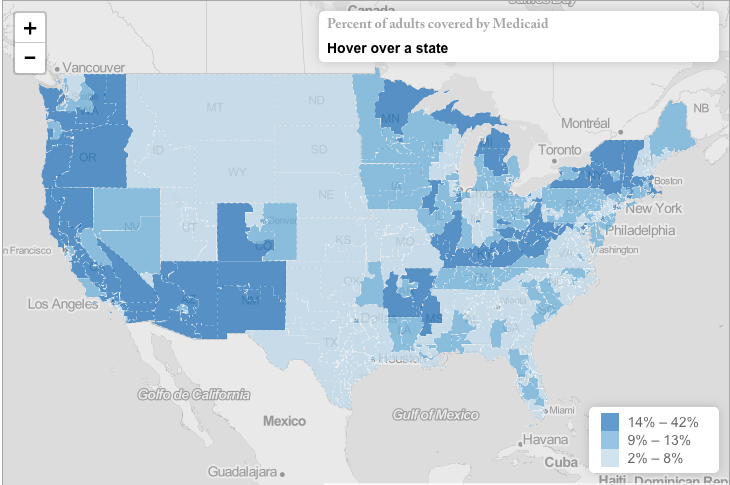
The interactive maps and data for 2016 provide information on the percent of adults and children covered by Medicaid and/or CHIP.You can embed these maps on your website by selecting a state on the left then copying the embed code on the right side of the map and pasting it into a post on your…
-
Nation’s Progress on Children’s Health Coverage Reverses Course
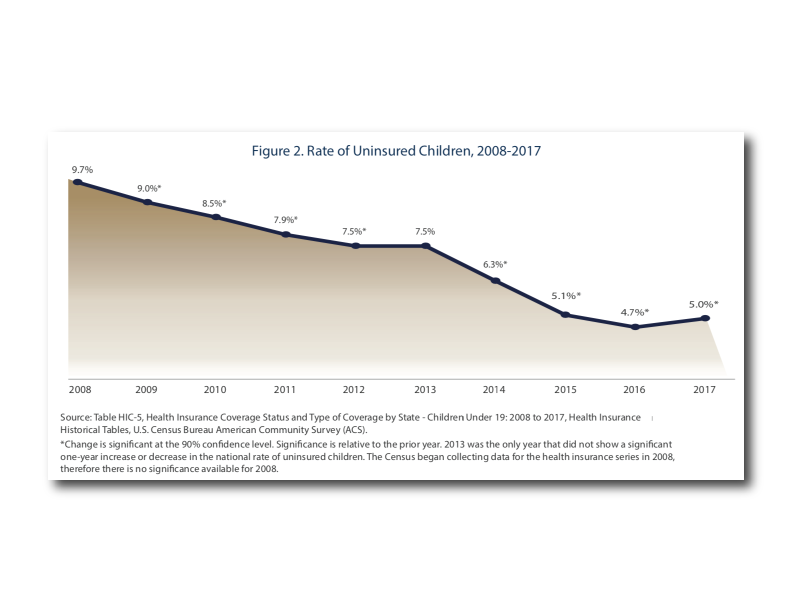
Introduction For the first time since comparable data was first collected in 2008, the nation’s steady progress in reducing the number of children without health insurance reversed course. The number of uninsured children under age 19 nationwide increased by an estimated 276,000 to about 3.9 million (3,925,000) in 2017, according to newly-available data from the…
-
State Medicaid and CHIP Snapshots, 2018
The Georgetown University Center for Children and Families (CCF) and the American Academy of Pediatrics (AAP) created factsheets underscoring the importance of Medicaid in providing coverage for children in all 51 states (including the District of Columbia). Sources are available here. Previous snapshots can be found here.
-
Nationwide Rate of Uninsured Children Reaches Historic Low
Nationwide 95.5 percent of children had health insurance in 2016, up from 95.2 percent the previous year—and up from 92.9 percent in 2013, the year before the ACA was fully implemented. While relatively few children rely on the ACA’s Marketplace for insurance, many gained coverage in Medicaid or CHIP when their parents signed up for…
-
Section 1115 Medicaid Waiver Comments
Georgetown University’s Center for Children and Families contributes an independent perspective to the public dialogue on the future of Medicaid through the lens of children and their families.
-
States Say They Will Run Out of CHIP Funds Faster than Projected; Will Congress Act in Time?
Ten states project they will run out of CHIP funds before the end of 2017 according to a new brief released by the Kaiser Family Foundation (KFF), based on responses from 42 states during the KFF’s annual Medicaid budget survey. The ten states are: Arizona, California, Connecticut, Hawaii, Idaho, Mississippi, Nevada, Oregon, Pennsylvania and Utah.…
-
State CHIP Snapshots
The Role of CHIP in Children’s Coverage In 2016 the children’s health insurance coverage rate in the United States dropped to just above 95 percent, an impressive achievement. Key to this success is the Children’s Health Insurance Program, which provides coverage to children who do not qualify for Medicaid but whose families cannot otherwise afford…
-
INTERACTIVE MAPS: Children Covered by Medicaid and CHIP by county, state or congressional district.
These maps show how many children are covered by Medicaid in each county and congressional district. Visit these links to view the maps, and to download handouts on your state’s coverage data: Percent of Children Covered by Medicaid/CHIP (congressional district) Percent of Children Covered by Medicaid/CHIP (county) Visit CCF’s State Resource Center for state-level data on health…
-
It Takes Time to Reduce Emergency Room Use
By Tara Mancini Last month, another round of results were released by the Oregon Health Insurance Experiment (OHIE). The examination found that emergency department (ED) use increased by 40 percent among those who were enrolled in Medicaid compared to the control group. The results raised an important and obvious question: what would ED usage look…
-
Children’s Coverage on the Eve of the Affordable Care Act
Here’s a good news story on health coverage that the public is largely unaware of. The number of uninsured children continues to decline to historic lows – a remarkable accomplishment given the high childhood poverty rate and tough economic times. Yet a majority of Americans are unaware of this achievement. In a poll CCF commissioned…
-
Children’s Health Coverage on the Eve of the Affordable Care Act
Georgetown University Center for Children and Families researchers analyzed health insurance data from the Census Bureau’s annual American Community Survey to get a closer look at children’s coverage trends. On the eve of the implementation of the Affordable Care Act coverage expansions, the authors found important lessons from the success the U.S. has had in covering children. The number of uninsured…
-
Covering Parents is Good For Kids: Continuous Coverage is even Better
By Tara Mancini A new study published in the Maternal Child Health Journal finds a positive relationship between continuity of coverage for adults and the likelihood that a child in the same household is also insured. The 30-month longitudinal study was conducted between 2003 and 2006 by researchers in Oregon who identified adults eligible for…
-
In the Midst of “Rate Shock” Fears, Insurers are Requesting Lower Rates in Oregon
By Sabrina Corlette, Center on Health Insurance Reforms An interesting thing happened in Oregon last week. The Division of Insurance(DOI) posted insurers’ proposed premium rates for 2014. That in itself isn’t so interesting – the DOI has one of the more transparent rate review programs in the country and publicly posts rates when they’re first filed. So these…
-
Oregon Study Adds to Growing Evidence of Positive Impact of Medicaid Coverage
The ongoing debate about the positive impact of Medicaid coverage has one more piece of evidence in its corner, as the second part of the Oregon Health Study was released today, finding that Medicaid “substantially improves the well-being of beneficiaries.” Back in 2008, an unprecedented opportunity arose as Oregon held a lottery for open slots in its Medicaid…
-
Getting Into Gear for 2014: Findings from a 50-State Survey of Eligibility, Enrollment, Renewal, and Cost-Sharing Policies in Medicaid and CHIP, 2012-2013
As 2013 begins, implementation of the major provisions of the ACA, including its coverage expansions, is less than a year away. Following the Supreme Court ruling to uphold the ACA and the 2012 elections, efforts to prepare for 2014 are moving into high gear in many states. The majority of states are capitalizing on web-based…
-
23 States Receive CHIPRA Performance Bonuses for Removing Barriers and Enrolling Children in Health Coverage
Demonstrating that covering kids is still a very high priority across the nation, twenty-three states earned CHIPRA performance bonuses for improving access to children’s health coverage and successfully enrolling eligible children. The states will split a total of nearly $306 million. The 23 states include: Alabama, Alaska, Colorado, Connecticut, Georgia, Idaho, Illinois, Iowa, Kansas, Maryland, Michigan, Montana,…