Medicaid
-
CMS Does Not Appear to Be Honoring Public Comment Requirement on Indiana Medicaid Waiver Request
My top-notch intern is checking the CMS website every day, and it looks like Friday June 9th, after regular business hours, federal CMS did two things with respect to Indiana’s desire to impose a work requirement on certain Medicaid beneficiaries and make other changes to their Healthy Indiana Plan (HIP) 2.0 program. First, CMS certified the application…
-
The Risk of Letting Politicians, Not Pediatricians, Determine Children’s Health Care
Fifty years ago, after learning that half the young men drafted for the Vietnam War failed baseline health exams, the federal government instituted Medicaid’s comprehensive, pediatrician-recommended benefit standard for children known as Early and Periodic Screening, Diagnostic, and Treatment (EPSDT). The federal benefit standard in Medicaid ensures that low-income and vulnerable children receive the health care services…
-
Connecting the Dots: Capping Medicaid, Closing Rural Hospitals, and Stranding Rural Children and Families
The Senate was designed by our founding fathers to protect less populated states. Few would dispute that over the decades, the Senate has faithfully executed that institutional mission, especially when it comes to health policy. So it is completely mystifying that the Senate, according to all reports, is seriously considering capping federal Medicaid payments to…
-
At Risk: Medicaid’s Child-Focused Benefit Structure Known as EPSDT
The federal benefit standard in Medicaid ensures that low-income and vulnerable children receive the health care services they need to grow and thrive. But this standard is at risk. Proposed cuts to Medicaid and CHIP funding could make EPSDT unaffordable to states, and in turn, proposed changes to federal policy, including legislative and administrative action, could potentially…
-
Medicaid is Increasingly Important for Kids and Families in Small Towns and Rural Communities
Since we started doing our annual report on uninsured children six years ago, the slightly higher overall rate for children living in rural areas has caught my eye. As a researcher, I always want to learn more about the populations that have higher uninsured rates. This year, with funding from the Pritzker Children’s Initiative, my…
-
Rural Health Report: Medicaid is a Lifeline for Small Towns and Rural Communities
Medicaid is a vital source of health coverage nationwide, but the program’s role is even more pronounced in small towns and rural areas. Medicaid covers a larger share of nonelderly adults and children in rural and small-town areas than in metropolitan areas; this trend is strongest among children. Demographic factors have an impact on this…
-
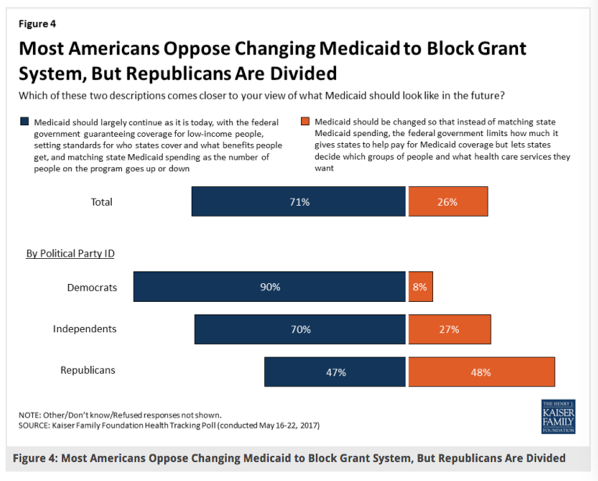
Public Firmly Opposed to Cutting Medicaid
The respected Kaiser Family Foundation health tracking poll released today confirms what we’ve been saying here at CCF for years – Medicaid is an extremely popular program that is a critical part of our health system. I recently detailed how Medicaid’s increasing importance to Americans has had a noticeable effect on health policy debates. Now…
-
How Many Will Be Impacted By Work Requirements: Indiana Gives Us The First Clue
As has been widely reported, there are a number of states seeking Section 1115 waivers to establish work requirements for their Medicaid expansion populations – and the Trump Administration has indicated that they are likely to say yes. In just the last week Arkansas and Indiana opened public comment periods at the state level for…
-
It is Complicated. A Child’s View Can Guide Us.
By Rylin Rodgers, Riley Child Development Center Too often policy discussions and budget debates are framed in terms of winners and losers at the program, department, or budget line level. Families raising children who have health care needs and disabilities are impacted every day by public policy, systems, and services related to health care, education, housing,…
-
No Doubt About It: Medicaid Capped, Uninsured Increased, and Taxes Cut
Yesterday the Congressional Budget Office (CBO) and the Joint Committee on Taxation (JCT) released their estimate of the House bill to “repeal and replace” the Affordable Care Act (ACA). The Senate, and seemingly much of Western Civilization, has been on CBO/JCT watch since the House of Representatives narrowly passed the bill on May 4 with…
-
Trump’s Proposed Budget Would Repeal the Maintenance of Effort Provision
The President’s FY 2018 budget, released yesterday, proposed repealing the maintenance of effort (MOE) provision as of October 1, 2017. As readers of Say Ahhh! already know, the MOE has been critical to maintaining stability for children’s coverage – and even improving coverage levels – while the rest of the health care system in the…
-
Fact Sheet: The Maintenance of Effort (MOE) Provision in the Affordable Care Act
The Affordable Care Act (ACA) included a “maintenance of effort” (MOE) provision that has ensured stability of coverage for children in Medicaid and CHIP, even as the rest of the U.S. healthcare system has seen significant change. The MOE—along with coverage expansions for parents and other adults in Medicaid and the Marketplaces – has helped…
-
Trump Budget Poses Even More Threats to Children’s Health
Today President Trump’s budget came out and the news for children’s health coverage is devastating. In addition to assuming the enormous cuts and dangerous changes to Medicaid included in the House passed American Health Care Act (that we have blogged about many times), the President is proposing even larger cuts to Medicaid and is proposing…
-
Capping Medicaid: Bad News for All
As readers of SayAhhh! know, the House bill to “repeal and replace” the Affordable Care Act does far more than effectively end the expansion of Medicaid for low-income adults. It also radically disrupts the 50-year old Medicaid partnership between the federal government and the states by capping federal payments to the states for covering all…
-
Impact of Medicaid Per-Capita Cap Cuts Underestimated by Many
The American Health Care Act, passed by the House and now currently being considered by the Senate, significantly cuts Medicaid in two ways. First, the AHCA rolls back the expansion of Medicaid to adults with incomes below $16,643 (138% FPL). Second, the AHCA institutes a “per-capita cap” or limit on how much the federal government…
-
Further Evidence that Medicaid and CHIP Have Played Significant Role in Nation’s Success in Covering Children
Efforts to connect kids to coverage over the past decade were accelerated by the Affordable Care Act (ACA) and are paying off big! A new report by the Urban Institute shows that the number of uninsured children who were eligible but not enrolled in Medicaid fell by 40% in just two years between 2013 and…
-
Wisconsin Waiver Would Create Unprecedented Barriers to Medicaid Access
Wisconsin officials are seeking unprecedented changes in the state’s Medicaid coverage for adults without dependent children. The draft proposals (summarized here) would significantly increase the number of uninsured Wisconsinites, make the state less healthy, and impede efforts to increase the Wisconsin workforce. From a national perspective, the section 1115 waiver that Wisconsin is seeking would…
-
Medicaid Per Capita Cap Threatens Children with Disabilities
Proponents of the American Health Care Act (AHCA),which both effectively eliminates the ACA’s Medicaid expansion AND establishes a cap on federal spending cap for the entire Medicaid program, often say that they are preserving the Medicaid program for the “most vulnerable.” The AHCA would actually do the opposite for the most vulnerable children on Medicaid…
-
Proposed Medicaid Changes Would Put Medical Decisions for Kids in Hands of States Instead of Parents and Pediatricians
In a recent interview with CNN’s Jake Tapper, Secretary Price spoke about the efforts underway to change our health care system. In fact, there’s much discussion in DC these days about health care – who should have it, how much it should cost, and which benefits should be included. While there’s room for improvement on…
-
Proposed Changes to Medicaid Threaten Access to Health Care
In the 1990s, the Medicaid program was often discussed by policymakers as a secondary topic after dealing with issues surrounding Medicare and reforming managed care. There were several reasons for this. Medicaid was seen as a “welfare” program targeted at specific poor populations. The country still hadn’t yet experienced the deep recessions that would mean…