Arizona
-
Almost All Custodial Parents, Caretaker Relatives Should Not be Impacted by Medicaid Work Reporting Requirements in 28 States
As states rush to implement complex new work reporting requirement provisions before January 2027, the new Interim Final Rule (IFR) released by the Centers for Medicare and Medicaid Services (CMS) has caused massive confusion. However, the IFR made important clarifications about which adults are not subject to work reporting requirements (WRRs), are excluded from WRRs,…
-
In-State Call Answer Rates for 988 Lifeline
The 988 Suicide and Crisis Lifeline went live in July 2022 to connect people experiencing mental health-related distress with trained counselors to provide help. Just as 911 is universally known for use during emergencies, like a heart attack or car accident, contacting 988 can be lifesaving for people experiencing a mental health crisis. The 988…
-
Trump Administration Issues Section 1115 Medicaid Waiver Financing Guidance Which Goes Far Further Than H.R. 1 (Again)
On Friday, June 11 the Centers for Medicare and Medicaid Services (CMS) issued new guidance on the Secretary’s approach to implementing Section 1115(g) which was added to the Social Security Act by H.R. 1 – the President’s signature budget bill enacted last year. (Our explainer of the health provisions in the bill can be found…
-
Uninsured Rate for Young Children Rose More Sharply than for Older Children from 2022-2024
Key Findings The number of infants, toddlers and preschoolers who are uninsured is at the highest level in nearly a decade and is increasing more sharply than for older children. The number of uninsured children under age 6 grew by 23% between 2022 and 2024, while the number of uninsured school-aged children grew by 17%. The charts and appendix…
-
Tracking Arizona Implementation of H.R. 1 Medicaid Work Reporting Requirements
Medicaid Enrollment Trends The CCF Enrollment Tracker uses the most recent monthly administrative data from state websites and the Centers for Medicare & Medicaid Services (CMS). State administrative data is often the quickest way to assess what is happening in a state’s Medicaid program. Arizona posts monthly state administrative data, including Medicaid enrollment. Timely administrative…
-
Is Your State Leaving Money on the Table? How CHIP Health Service Initiatives Can Help States Support Children’s Access to Care
At a time when states are facing growing fiscal pressures and increasing strain on health systems, the Children’s Health Insurance Program (CHIP) Health Services Initiatives (HSIs) represent an often overlooked source of federal funding offering flexible financing to support outreach and targeted health initiatives to improve children’s health. This source of federally-matched funding becomes increasingly…
-
State by State Medicaid and CHIP Enrollment Data
This tracker shows enrollment data for Medicaid and the Children’s Health Insurance Program (CHIP) in all 50 states and DC, from January 2025 to the most recent month available. Data include total Medicaid/CHIP enrollment, as well as enrollment for children, adults, and Medicaid expansion. Historical data are also included to provide additional context for state…
-
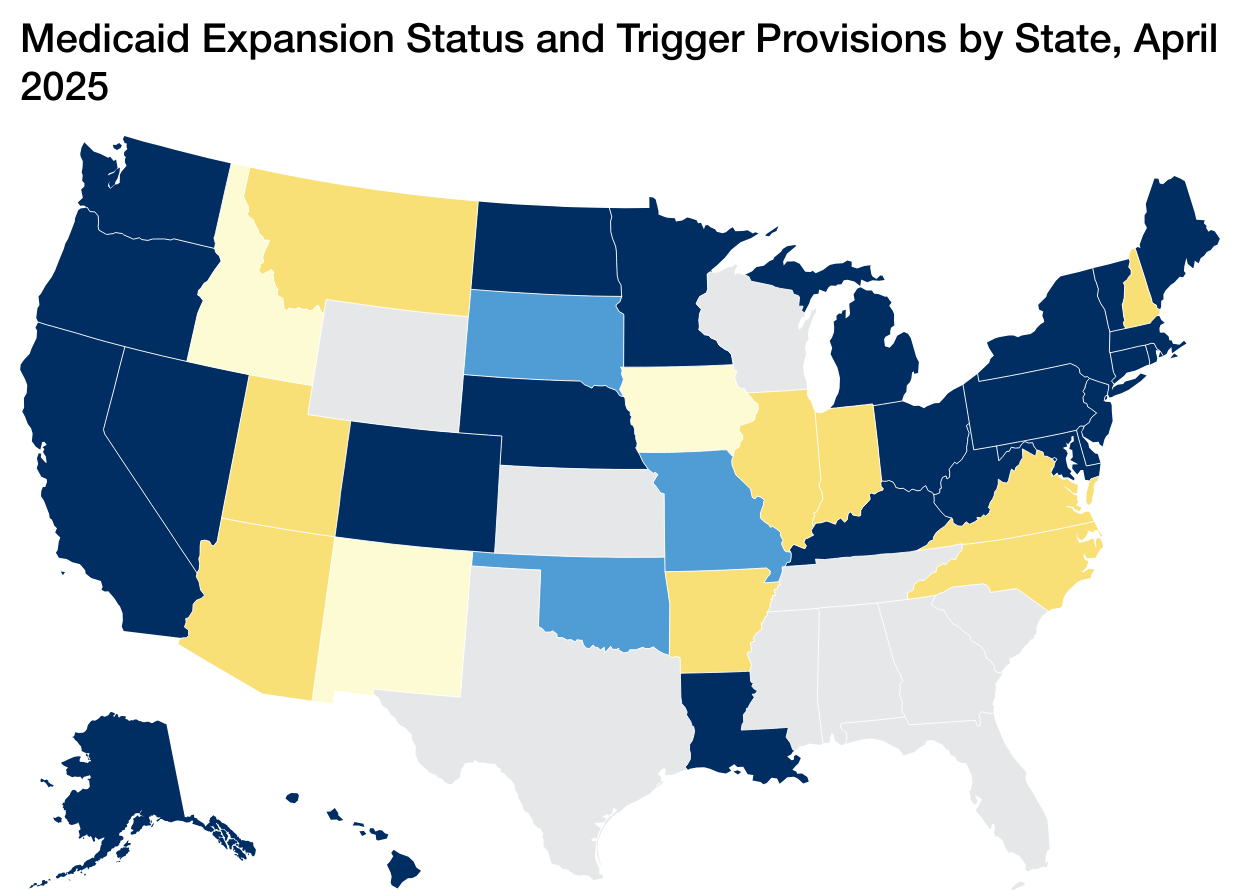
How Would Changes to Federal Medicaid Expansion Funding Impact People in “Trigger” States and Those with Expansion Enshrined in State Constitutions?
Congress is currently considering draconian cuts to Medicaid that would mean millions of low-income Americans lose access to affordable health care. But both the type of federal cuts and how the joint state-federal Medicaid program operates in each state mean that the impact on people living in different states would vary considerably. The major difference…
-
Medicaid’s Role in Small Towns and Rural Areas
Key Findings Background One-fifth of people in the United States live in areas that are classified as non-urban. Residents of rural areas and small towns face additional challenges accessing needed health services compared to residents of metro areas for a variety of reasons including acute provider shortages, limited connectivity, and long distances to travel to…
-
Medicaid Managed Care and Early Childhood Development: A 12-state Scan
Summary and Key Findings The first five years of a child’s life are a period of rapid growth and development. During this time, frequent check-ups are essential to monitor a child’s progress so that if a problem is identified an intervention can occur before things get worse. Medicaid, a primary source of health care coverage…
-
Federal Funding Cuts to Medicaid May Trigger Automatic Loss of Health Coverage for Millions of Residents of Certain States
Despite virtually no discussion of Medicaid during the election, Medicaid is facing proposals for significant reductions in federal funding. My colleague Edwin Park has already detailed some of the discussion around these cuts – which are being considered in service of facilitating an extension of tax breaks, the majority of which would go to the…
-
State Medicaid and CHIP Snapshots, 2023
The Georgetown University Center for Children and Families (CCF) and the American Academy of Pediatrics (AAP) created factsheets underscoring the importance of Medicaid in providing coverage for children in all 50 states and the District of Columbia. Sources available here. Previous snapshots can be found here (2019), here (2018) and here (2017). Check out more interactive…
-
Unwinding Data from Arizona – April 1, 2023
On April 1, 2023, the Arizona Health Care Cost Containment System uploaded a new ‘Population by Category’ spreadsheet, which included Medicaid coverage loss as of April 1. View the Spreadsheet
-
First Round of Medicaid Disenrollment Data Is In Quickly: What We Know and Don’t Know
Five states (AR, AZ, ID, NH, SD) started disenrolling people from Medicaid last weekend (April 1st) as the unprecedented Medicaid “unwinding” begins. As readers of SayAhh! know, in exchange for extra federal funds, states have been prohibited from disenrolling anyone involuntarily from Medicaid since March 2020 due to the COVID-19 public health emergency. Quicker than…
-
New Data Underscores Need to Catch up on Routine Childhood Vaccinations
The Centers for Disease Control and Prevention (CDC) released updated data on vaccination coverage among kindergartners, showing a continued decline in the share of children with the recommended doses of routine childhood vaccines needed to prevent the spread of harmful diseases. The report includes data on vaccination rates by state for four vaccines: measles, mumps,…
-
Number of uninsured Arizonans grew by 60K last year, report says. And then the pandemic hit.
AZ Central By: Stephanie Innes The number of Arizonans without health insurance grew by nearly 64,000 people in 2019, well before the COVID-19 pandemic that may swell those ranks, new Census data says… In her blog post, Joan Alker of Georgetown University wrote that Latino children saw the largest jump in their already high uninsured…