Eligibility & Enrollment
-
Child Uninsured Rate in 2021: Medicaid’s Continuous Coverage Provision is Helping
Children’s uninsured rate decreased from 2020 to 2021, according to new Early Release data from the Centers for Disease Control and Prevention’s National Health Interview Survey (NHIS). According to the NHIS, uninsurance for children under age 18 fell to 4.1 percent in 2021. Using this data source, the uninsured rate had remained steady at 5.1…
-
HHS and CMS Request FCC Opinion on Text Messaging by Contractors and MCOs
HHS Secretary Becerra and CMS Administrator Brooks-LaSure have formally asked for an opinion from the Federal Communications Commission (FCC) regarding whether certain text messages and automated, pre-recorded telephone calls to individuals’ cell phones are permissible under the Telephone Consumer Protection Act (TCPA). Prior rulings from the FCC have confirmed that neither federal nor state governments…
-
More Children Enrolled in ACA Marketplace Coverage in 2022, But Marketplaces Still Remain Modest Source of Health Coverage for Children
Medicaid and the Children’s Health Insurance Program (CHIP) currently cover more than 40 million children. In comparison, relatively few children rely on the marketplaces for their health coverage. But new data released by the Centers for Medicare & Medicaid Services (CMS) show 1.3 million children were enrolled in marketplace plans during the 2022 Marketplace Open…
-
Once Again, Secretary Becerra Extends the PHE: What Does This Mean for the Medicaid Continuous Coverage Protection?
[Editor’s Note: Read the latest on the public health emergency Medicaid continuous coverage protection here.] It’s no surprise that HHS Secretary Becerra has renewed the COVID-related public health emergency (PHE) until July 15, 2022, since the Biden administration did not signal an end to the PHE 60 days in advance of the April 16, 2022…
-
At Long Last, the Biden Administration Takes Step to Fix the Family Glitch
Back in 2014, I wrote about the importance of fixing the family glitch in this Health Affairs policy brief, which I, along with other health policy wonks, thought could be fixed administratively through rule-making. At last, the Biden administration has announced steps to do so with a White House event featuring former President Obama, whose…
-
CMS Shares State Reporting Requirements on PHE Unwinding, but Will the Agency Share State Reports with the Public?
We’ve been expecting CMS to release a template for states to report key baseline and monthly data that is needed to monitor the unwinding of the Medicaid continuous coverage protection, but we got more than that with today’s release. CMS will also require states to complete and submit a form that summarizes the state’s approach…
-
Medicaid and CHIP Eligibility and Enrollment Policies as of January 2022: Findings from a 50-State Survey
Executive Summary Enrollment in Medicaid has grown significantly during the coronavirus pandemic. Provisions in the Families First Coronavirus Response Act (FFCRA) require states to provide continuous coverage for Medicaid enrollees until the end of the month in which the public health emergency (PHE) ends in order to receive enhanced federal funding. Continuous enrollment has helped to preserve…
-
What Can States Do to Reduce Risk of Children Unfairly Losing Health Insurance
In part 1 of this blog series, my colleague and report co-author Joan Alker, explained the dire consequences if states don’t put in the time and effort to get renewals right when the Medicaid continuous coverage provision is lifted. This blog will focus on how we developed risk assessments for children in all 50 states…
-
Research Update: More than 1 in 3 Children Lacked Access to Adequate Coverage in 2019
Regular readers know that, since record lows in 2016, child uninsurance has been climbing in recent years. Regular readers also know that uninsured rates don’t give a full picture of children’s coverage. Similar to our recent paper on kids who experience coverage gaps, a new article in Pediatrics shows that just having some health insurance…
-
A Few Key Data Points Are Essential in Monitoring Medicaid Enrollment When the Continuous Enrollment Requirement is Lifted
The lifting of the continuous enrollment requirement associated with the COVID-19 public health emergency (PHE) is inevitable, whether it be after the PHE ends or on April 1, 2022 as proposed in the Build Back Better (BBB) Act passed by the House. Regardless of what happens, millions of enrollees are likely to be disenrolled from…
-
Gaps in Coverage: A Look at Child Health Insurance Trends
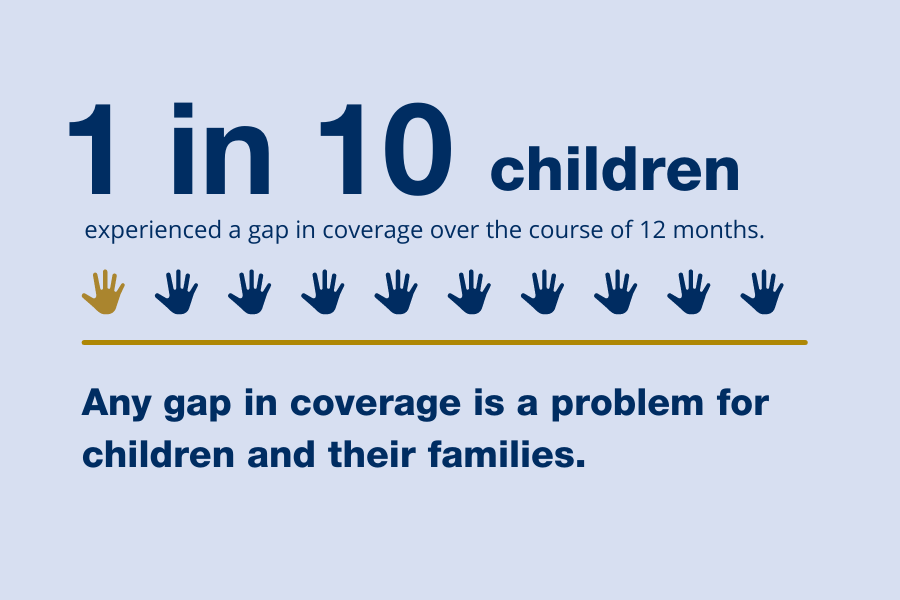
The number of uninsured children was on a downward trajectory for many years, but in 2017 started going back up, rising a full percentage point between 2016 and 2019 (see Figure 1). This issue brief examines the incidence and characteristics of children who experienced a period of uninsurance over the course of a recent year…
-
Build Back Better Act: Health Coverage Provisions Explained
On November 19, 2021, the House of Representatives passed the Build Back Better Act, the budget reconciliation bill, with the Senate expected to consider the legislation in coming weeks. The Build Back Better Act includes numerous provisions that would dramatically strengthen and expand both public and private health insurance coverage. Some of the new provisions…
-
Reconciliation Bill Would Phase Out Medicaid Continuous Coverage Requirement with Key Enrollee Protections
There are many positive provisions in the Build Back Better Act (BBB) reconciliation bill as described by my colleague, Edwin Park, including filling the Medicaid coverage gap in non-expansion states, extending postpartum coverage, and making CHIP permanent. The BBB bill also phases out the 6.2 percentage point increase in the federal Medicaid funding and allows…
-
To Avoid Big Coverage Losses, Marketplaces Need to Prepare for the End of the Public Health Emergency
By Sabrina Corlette and Megan Houston The COVID-19 pandemic will end, and with it the federal government is expected to lift the “Public Health Emergency” (PHE) first declared on January 31, 2020 and extended seven times since then. Allowing the PHE to expire is more than the symbolic end of the pandemic; it signals the termination of numerous policies…
-
What’s New for 2022 Marketplace Enrollment?
Open Enrollment is just around the corner. There are new policies for the marketplace in 2022, including an expansion of opportunities to sign up for health coverage during and outside the annual open enrollment period. There are also new opportunities to get financial help with the enactment of the American Rescue Plan (ARP) Act. Here…
-
Covid-19 Exposed Many Inequities for Latino Families, Adopting Continuous Eligibility Would Repair Cracks and Protect More Latino Kids from Losing Medicaid/CHIP
COVID-19 underscores the need for universal access to health care and exposes the coverage inequities in our system today. Latino children are more likely to be uninsured than their non-Latino peers, and this coverage gap widened in recent years. A new report from CCF and UnidosUS shows that because Latino children are more likely to be…
-
Advancing Health Equity for Children and Adults with a Critical Tool: Medicaid and Children’s Health Insurance Program Continuous Coverage
Key Takeaways: Latino children disproportionately receive their health coverage through Medicaid or CHIP. Together, these programs provide coverage for more than one-third (37.6 percent) of all children, but more than half (52.1 percent) of Latino children. Adopting Medicaid and CHIP policies that remove barriers to participation and reduce gaps in coverage would narrow inequities in…
-
Medicaid Continuous Coverage Extended with Renewal of the PHE
The Biden administration has extended the public health emergency (PHE) for 90 days, from October 18, 2021 through January 16, 2022. What does this mean for Medicaid? First, the maintenance of effort provisions in the Families First Coronavirus Response Act remain in effect until January 31, 2022 (the end of the month after the PHE…
-
Why is Medicaid/CHIP Continuous Eligibility So Important for Kids?
As readers of SayAhhh! know, the number of uninsured kids was going down for many years, but during the Trump administration starting going back up – rising to 5.7 percent child uninsured rate in 2019. While children are insured at higher rates than non-elderly adults, they still lag considerably behind seniors – who with Medicare…
-
Loss of Medicaid After the PHE Will Likely Exceed 15 Million Estimated by Urban
The Urban Institute recently released a new report projecting that Medicaid and CHIP will have provided access to health care (and peace of mind) for an additional 17 million children and adults by the end of 2021. The increase is largely due to the COVID-related requirement that states keep Medicaid enrollees continuously covered during the…