

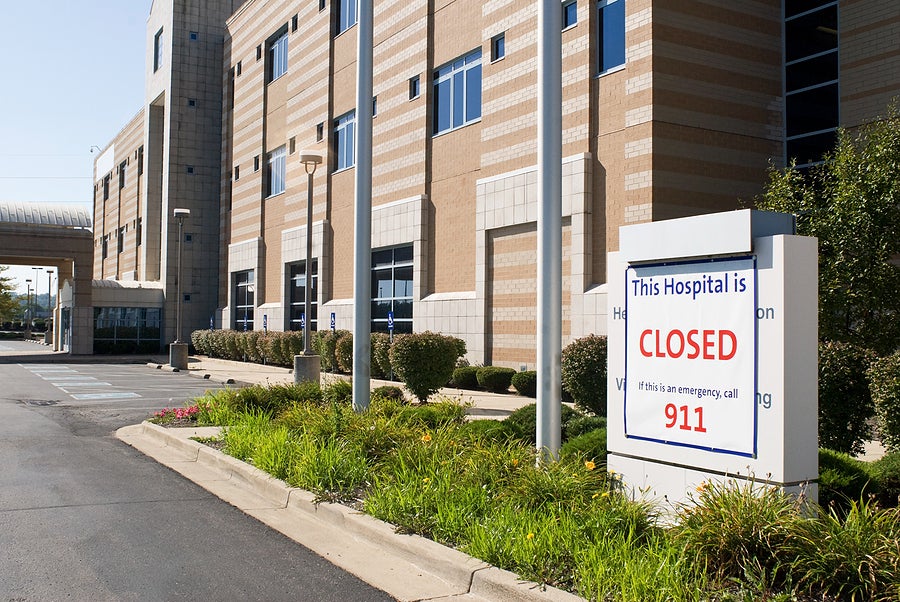
More stories have been published across the country in recent weeks detailing how the federal cuts to health care passed last year by Congress and signed into law by President Trump in H.R. 1, “The One Big Beautiful Bill”, are affecting communities. One emerging theme is that the Rural Health Transformation Fund – a $50 billion fund distributed to states that was created under H.R. 1 to offset the impact of Medicaid cuts in rural America – isn’t doing much to soften the blow of the nearly $1 trillion of cuts to Medicaid in the bill.
These stories reflect the same bipartisan concern identified in my last blog about the effect of these health care cuts, and increasing worry about how rural hospitals and rural health clinics are particularly at risk.
For example, in Nebraska and other states, rural hospitals are facing across-the-board cuts – and the rural health fund Congress created to offset the impact of Medicaid cuts on rural health care is falling short:
“Hundreds of rural hospitals across the country are facing closures after years of funding problems. The issue was compounded last summer by the Trump administration’s massive cuts to Medicaid, the government’s safety net for low-income Americans, whose reimbursements have long helped hospitals meet their bottom lines.
Outcry over the funding cuts prompted Republican lawmakers to create $50 billion in new rural health grants, but critics say that funding is intended for innovative health care delivery solutions — not propping up hospitals buckling under current pressures.”
— Concerns over a Nebraska hospital show how a $50B rural health fund is coming up short, Associated Press, April 3, 2026
And the concern over Medicaid cuts in Nebraska isn’t confined to hospitals. A rural health clinic CEO recently expressed concern over the coming federal Medicaid cuts:
“Bluestem Health, a clinic that serves low-income and uninsured patients in Lincoln, Nebraska, has lost money for the last two years.
And CEO Brad Meyer fears times will soon get worse for the clinic and its 21,000 patients. That’s because Nebraska is set to become the first state to require certain Medicaid enrollees to work or lose their coverage under new rules in President Donald Trump’s One Big Beautiful Bill Act….
Most of Bluestem’s patients are covered by the government program for people with low incomes or disabilities. Meyer estimates up to 15% of them may be kicked off Medicaid, which could cost his center about $600,000 a year. That could mean cutting services or staff….
Most are expected to lose coverage not because they don’t work but because of paperwork errors, like failing to document their hours or verify that they qualify for an exemption.”
— Trump’s One Big Beautiful Bill Act Darkens Outlook for Government-Backed Clinics, Nebraska Examiner, KFF Health News, March 29, 2026
Other affected services in Nebraska from H.R. 1 Medicaid cuts include cutting of a dialysis service unit in a rural hospital:
“Jon Reiners, CEO of the independent, nonprofit Chadron Hospital, wrestled with the decision to end dialysis services. He and several patients said that the closure was announced as Nebraska officials celebrated the $219 million the state will receive in first-year funding from the Rural Health Transformation Program.
But the five-year program is aimed at exploring new, creative ways to improve rural health, not to help existing services stay afloat. States can use only up to 15% of their funding to pay providers for patient care.”
— Rural Nebraska Dialysis Unit Closes Despite the State’s $219M in Rural Health Funding, KFF Health News, April 15, 2026.
Likewise, in North Carolina, policymakers are warning that money from the new federal rural health fund will not make up for the large accompanying Medicaid cuts:
“The federal program was created as a way to funnel money to rural health care providers, in response to the massive cuts to Medicaid that President Donald Trump and fellow Republicans in Congress passed into law last year. Rural people disproportionately rely on Medicaid, which provides health care for low-income families.
The Medicaid cuts are expected to drain billions of dollars out of North Carolina’s health care economy, according to hospital industry leaders. The $213 million from the new project would cover a small portion of those expected losses.”
— Rural health care in focus: NC lawmakers raise concerns over shortage of nurses, doctors, WRAL, March 29, 2026
Discussion among policymakers in North Carolina was driven by comments like these, warning of major service cuts coming for rural hospitals as a result of H.R. 1:
“Executives with FirstHealth of the Carolinas, a system of four not-for-profit hospitals that serves counties in central and southwestern N.C., told the Joint Legislative Oversight Committee on Health and Human Services that its health network is facing a decline in operating income over the next five years, and is projected to be operating at a loss in 2032. Medicare and Medicaid pay nearly 70% of its patients’ hospital bills.
“HR1 doesn’t just affect our finances, but it affects what services are going to remain locally,” said Autumn McFann, FirstHealth’s chief financial officer.”
— Rural hospital system asks NC lawmakers for help in the face of federal cuts, NC Newsline, April 7, 2026
And in New Hampshire, the CEO of a rural health center has the same concerns as in Nebraska and North Carolina. One health clinic has already closed:
“Edward Shanshala, CEO of Ammonoosuc Community Health Services, said when Congress passed its massive tax cuts and spending law last year, he and his colleagues made the difficult decision to shut down the organization’s clinic in Franconia in anticipation of the law’s impacts. Shanshala doesn’t think a new tranche of federal funding will be enough to fully alleviate the pressures his organization is facing.”
— Coös County health center CEO says new rural health funds not enough to counteract Medicaid cuts, New Hampshire Bulletin, April 9, 2026
Minnesota has struggling institutions as well, especially in rural areas. A recent expansion by a rural hospital system is under threat and the system is now not looking at how to provide more services to the area, but what they may have to cut just to stay open as a result of H.R. 1:
“But by the time that cancer center opened last summer, a crucial funding stream had disappeared. Days before, President Donald Trump had signed what he dubbed the “One Big Beautiful Bill Act,” a multitrillion-dollar package of tax breaks and spending cuts that slashed nearly $1 trillion from Medicaid. The program for poor and disabled Americans accounts for more than a fifth of Astera’s payer mix.
Now, Astera officials are scrambling to recalculate already razor-thin margins so the only hospital for miles around — and the biggest employer in town — can stay open. Like states across the country, the reliance on federal dollars is most pronounced in Minnesota’s rural communities, which tend to be older and poorer than metro areas.
— Rural Minnesota economies under threat as feds cut safety net programs, The Minnesota Star Tribune, April 12, 2026.
Similarly, a rural hospital in Virginia is closing its observation unit, citing the Medicaid cuts in H.R. 1:
“Valley Health’s Winchester hospital will close its observation unit by July 1 to save money. Observation units are used to monitor patients that are too sick to discharge but don’t need to be admitted for longer term care. People needing observation care will be tended to in existing inpatient units while observation staff will be transitioned into other areas of Valley Health.
Mark Nantz, president and CEO of Valley Health, attributed the changes as a response to how health care is evolving nationally. A rule from the Centers for Medicare and Medicaid Services late last year reduced reimbursements while the H.R. 1, also known as the “One Big Beautiful Bill,” is expected to spur drops in Medicaid enrollment nationwide.
— Valley Health changes staffing contracts, trims service citing ‘Big Beautiful Bill’, Virginia Mercury, April 17, 2026.
Finally, in Oklahoma, a major system of health clinics across the state are planning multiple clinic closures across different health care services, citing the Medicaid cuts in H.R. 1:
“Health system says patients will receive at least 30 days’ notice as dermatology, pediatric and mental health services face shutdowns…
The announcement comes just one month after the health system said it would close its child care centers in August. Officials now say additional operational changes are ahead.
In a statement, INTEGRIS said the decisions are tied to cuts to Medicaid and Medicare funding included in the federal legislation known as the “One Big Beautiful Bill.” The health system says those funding reductions are expected to result in a $130 million loss for the medical group.”
—INTEGRIS Health plans clinic closures across Oklahoma citing $130M funding loss, NEWS9, April 17, 2026.
What is quickly becoming clear, even at this early stage, is that as a result of the cuts enacted by Congress, health care is going to become much harder to access for many people. Rural areas and small towns across the country will be particularly affected.
I’ll keep surveying the effects on the ground from the implementation of the health care cuts in H.R. 1 and share what I find on the blog.
[Editor’s Note: This post is part of a blog series on the impact of H.R. 1 Medicaid cuts and policy changes on small towns and rural communities.]