All
-
The CMS Administrator Talks to Medicaid Directors About Humility in Government
Two years ago, CMS Administrator Seema Verma gave a major policy address to the National Association of Medicaid Directors (NAMD) at which she outlined her agenda for Medicaid. She invoked Hubert Humphrey and Lyndon Johnson on the moral imperative of meeting the needs of the poor. She promised to give states more flexibility by, among other…
-
New Resource from Legal Experts about Access to Health Insurance
Earlier this month, the experts at CLASP, NILC and NHeLP teamed up and released a new resource, 10 Facts About Access to Health Insurance for Immigrants and their Families, breaking down the barrage of anti-immigrant polices in just 2, easily understood pages. This resource comes just in time for open enrollment – for ACA Marketplace…
-
News about Future of Children’s Dental Health Project
[Editor’s Note: The Children’s Dental Health Project, a longtime partner of Georgetown University’s Center for Children and Families, asked that we share the following news with our readers.] As leader of the Children’s Dental Health Project (CDHP), I have some news to share about our future. After extensive deliberation, CDHP will be moving our oral…
-
Medicaid Expansion Proves Once Again to be Popular with Voters/Work Reporting Requirements are Not
Health care was one of the top issues on the minds of voters in Kentucky and Virginia last night and they voted in favor of Democrats who support a clean Medicaid expansion and against Medicaid work requirements – a signature issue for CMS Administrator Seema Verma. Kentucky was an early adopter of the Affordable Care…
-
States that Expanded Medicaid are Helping to Protect Children from Becoming Uninsured
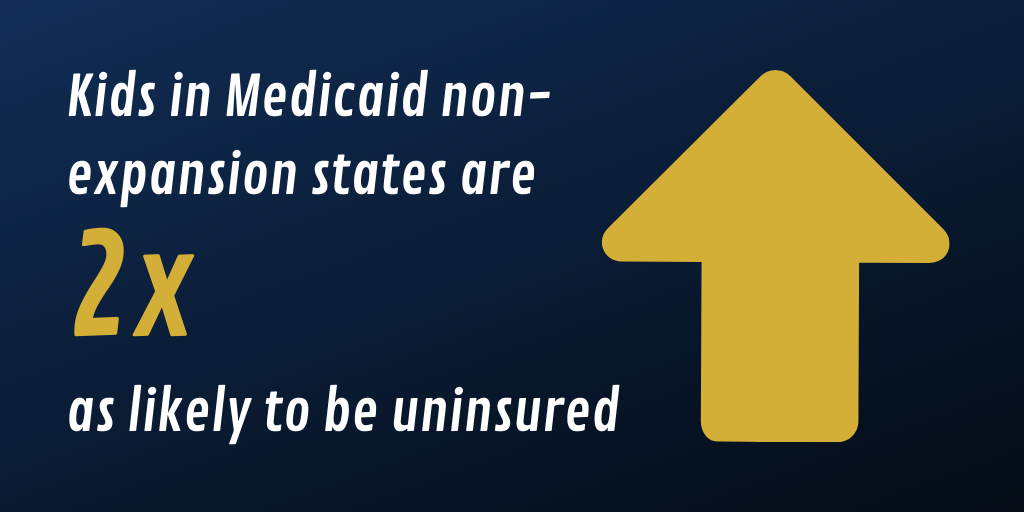
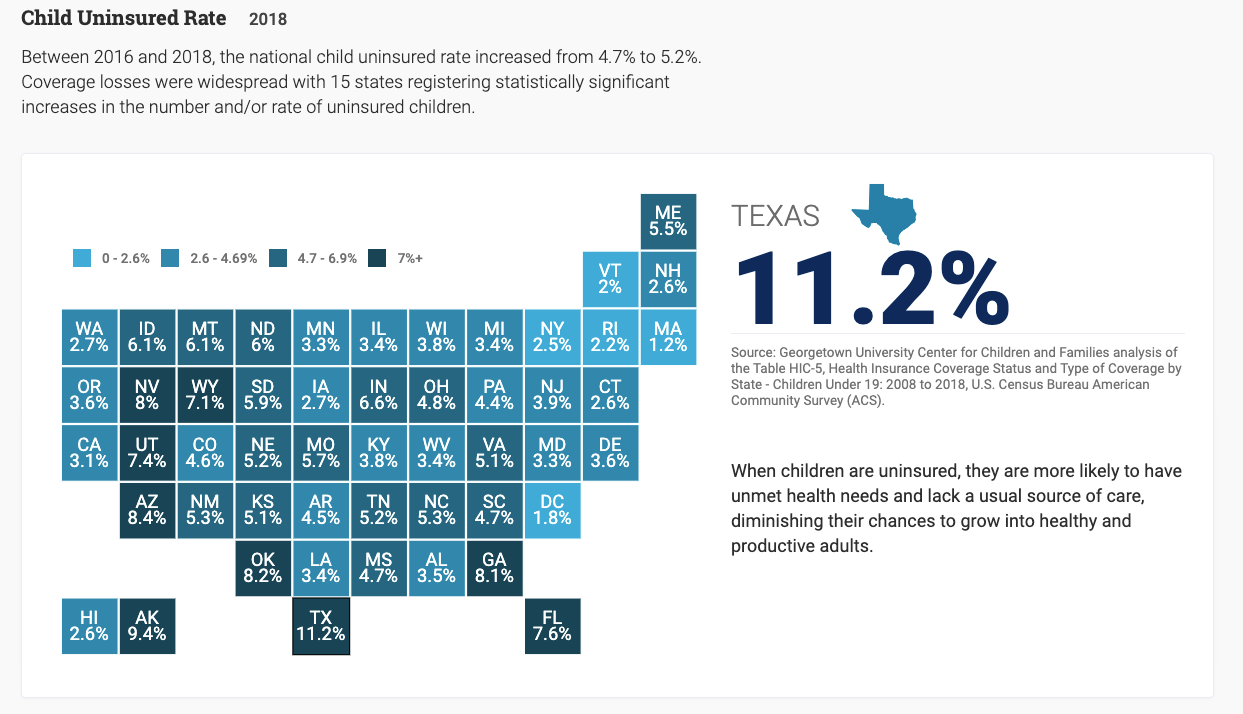
Our annual report on the state of children’s coverage is out. It’s a deep dive into a disturbing trend – children across the country are losing affordable health coverage, rolling back gains started with the Affordable Care Act. One main cause of this drop in coverage is easily fixed. The 14 states that haven’t expanded…
-
Renewing Bipartisan Commitment to Help Uninsured Children Should be Top Priority
Today we released our ninth annual report that tracks children’s health insurance coverage at the state and national level. This report looks at two-year trends from 2016 to 2018 analyzing American Community Survey data from the Census Bureau. We believe this is the first national report to look at this two-year time period, a time…
-
The Number of Uninsured Children is on the Rise
[Editor’s Note: For the most recent report on children’s health coverage, click here.] Introduction For many years, the nation has been on a positive trajectory reducing the number and rate of uninsured children. Having health insurance is important for children as they are more likely to receive needed services, have better educational outcomes, and their…
-
Improving State Administration and Procedures to Regain Medicaid/CHIP Enrollment Momentum for Kids
See our full blog series on evidence-based policies available to policymakers to prevent more eligible children from losing health coverage. As Say Ahhh! readers know, in May, we released a comprehensive report showing that child enrollment dropped by nearly 1 million children in 38 states in 2018 and have continued to track the growing enrollment…
-
Maximizing the Use of Technology to Regain Enrollment Momentum in Medicaid
See our full blog series on evidence-based policies available to policymakers to prevent more eligible children from losing health coverage. As Say Ahhh! readers know, in May, we released a comprehensive report showing that child enrollment dropped by nearly 1 million children in 38 states in 2018 and we have continued to track the growing…
-
Here are the Facts About Anti-Immigrant Policies Pushed by the Administration and Their Impact on Children and Families
It’s hard to keep up these days on the policies pushed by this Administration that unfairly target immigrant families, but it’s important to be aware and to hold those who are in power accountable. Over the last two years, we’ve tracked harmful policies such as “zero tolerance” at the border and changes to public charge…
-
New Georgetown CHIR Report Finds Ability of Insurers, Employers to Respond to Provider Consolidation is Limited
Most employers are implementing few, if any, changes to their health plans for the 2020 plan year. That’s not surprising – employers are generally reluctant to make big or abrupt adjustments to provider networks or cost-sharing that could cause pushback from employees. But many health care experts believe that if we’re ever to truly tackle out-of-control health care…
-
The Number of Uninsured Children is on the Rise
Georgetown University Report Finds Number of Uninsured Children Now at Highest Levels Since Major Provisions of Affordable Care Act Took Effect State-by-state analysis shows alarming trend is widespread and occurred during a period of economic growth when children should be gaining health coverage Note to Editors: Detailed state information available in new interactive data hub…
-
What’s New for 2020 Marketplace Enrollment?
On November 1, the seventh open enrollment period begins for marketplace coverage under the Affordable Care Act (ACA). We at CHIR are tracking several policy changes that could affect marketplace enrollment and plan affordability in 2020. These include: Public Charge Rule: In August 2019, the Department of Homeland Security issued a final rule that broadens the types…
-
Most Recent CMS Data Show Child Enrollment in Medicaid/CHIP Dips Again in June 2019
In June, another 62,000 children lost Medicaid or CHIP coverage, bringing the 18-month enrollment decline (between December 2017 and June 2019) to more than 1.1 million children nationwide or an overall 3 percent drop. Based on CMS or state enrollment data, 37 states have experienced declines of enrollment ranging from less than 1 percent to…
-
GAO To CMS: Set Goals, Measure Progress on EPSDT (Do Better)
Another day, another area where CMS could be spending its valuable resources to fulfill Medicaid’s mission to provide health care to low-income Americans, including and especially children. The Government Accountability Office (GAO), Congress’s watchdog for federal agencies, has some ideas. Regular Say Ahhh! readers know the great potential of Medicaid’s pediatric benefit, called EPSDT. Medicaid…
-
Medicaid Expansion Debate: A New Phase
Across the states, moving towards an election year typically means a retreat from policymakers wanting to take on major issues of interest to their constituents for fear of offending one side or the other. In an era of increasing “constant campaigns” rather than actual governance, this can mean even more legislative paralysis. But health care…
-
Healthy Schools Campaign Webinar Looks at Importance of Medicaid to Student Success
Think fast: What the third largest stream of federal funding flowing into public schools? Since this is Say Ahhh!, you’re probably guessing Medicaid, and you’d be right. School districts across the country receive an estimated $4.5 billion in federal Medicaid dollars every year. That’s less than 1 percent of federal Medicaid spending, but in terms…
-
New Initiative Could Undermine ACA Consumer Protections Under Guise of ‘Wellness Program’
Before the Affordable Care Act (ACA) was enacted, one of the primary ways insurance companies deterred less healthy people from enrolling was to charge them into a higher premium based on their expected health risk. The ACA prohibited this practice beginning in 2014. Health insurers in the individual market can now adjust premium rates solely based…
-
Short-Term Funding Bill Keeps Government Open, Also Includes Sound Provision Reducing Federal and State Medicaid Drug Costs
On September 29, the President signed into law a fiscal year 2020 appropriations bill (H.R. 4378) that temporarily funds the federal government through November 21. The bill also includes several short-term extensions of critical health provisions that were scheduled to expire: full Medicaid funding for Puerto Rico and the other territories, a delay in scheduled…