Research & Reports
-
Children’s Health Coverage in Florida: Fewer Uninsured But Challenges Lie Ahead
Florida’s rate of uninsured children has declined in recent years, though it remains considerably higher than that of the nation and other southeastern states. This encouraging trend could be disrupted, however, by policy decisions in 2015 that could negatively impact as many as 400,000 children. This brief examines why Florida has one of the highest…
-
Policy Brief: Resolving Enrollment Conflicts as States Expand Medicaid
I wrote about this issue a couple months ago here on the blog and there was enough interest we’ve turned that piece into a policy brief. Basically, states moving towards expanding Medicaid have to deal with the fact that significant numbers of people who will now be eligible for Medicaid are already enrolled in health plans…
-
Renewing Coverage Through the Federal Marketplace
This brief describes how consumers will update their eligibility for financial assistance and renew enrollment in a QHP through the federal marketplace. It’s a smart choice for consumers to update their information and compare QHPs, which includes new plan choices in many areas. However, most consumers can keep the level of premium tax credits and cost-sharing…
-
Hispanic Children’s Coverage: Steady Progress, but Disparities Remain
The United States has cut the rate of uninsured children in half since 1997, due, in large part, to Medicaid and the Children’s Health Insurance Program (CHIP). A combination of children’s eligibility expansions through these two programs, as well as state and federal efforts to conduct outreach and simplify enrollment in both programs, has led…
-
Progress for Uninsured Children Slowing
Our nation has made historic progress covering children thanks to CHIP and Medicaid, but progress is slowing just as federal and state policymakers face important choices that will determine whether that success continues or reverses. Read this year’s 50-state report on uninsured kids, “Children’s Coverage at a Crossroads: Progress Slows.”
-
Children’s Coverage at a Crossroads: Progress Slows
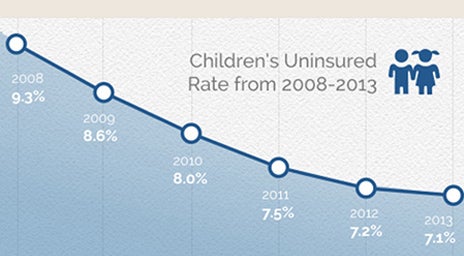
In 2013, for the first time in recent history, the uninsured rate for children did not significantly decline from the previous year, remaining just above seven percent. Yet in the past five years, the number of uninsured children declined substantially from just under 6.9 million to just over 5.2 million in large part due to…
-
Overview of Immigrant Eligibility Policies for Health Insurance Affordability Programs
The Georgetown University’s Center for Children and Families, in partnership with the Center on Budget and Policy Priorities, and the National Immigration Law Center Presented in a Series of Assister Webinars Focusing on Coverage Eligibility and Application Process for Families that Include Immigrants sponsored by the Centers for Medicare and Medicaid Services. Webinar 1: September…
-
A First Look at Uninsured Rate for Children Since Major Affordable Care Act Provisions Took Effect
Georgetown University CCF researchers teamed up with researchers at the Urban Institute to take a first look at how the Affordable Care Act is impacting the uninsured rate for children. The high level data indicate that, so far, there has been no detectable change nationally, although children’s uninsured rates remained at historically low levels. The…
-
Medicaid’s Role in Improving Early Childhood Outcomes
Today, more than 27 million children are covered through Medicaid and CHIP. For the youngest children, Medicaid plays a critical role: More than 45 percent of children under age six are publicly insured. Nearly one in five Medicaid beneficiaries in the U.S. nationwide is a child under age six. Medicaid’s requirement that children receive strong,…
-
Dismantling CHIP in Arizona: How Losing KidsCare Impacts a Child’s Health Care Costs
On January 31, 2014, an estimated 14,000 Arizona children lost their health coverage under KidsCare II, a temporary extension of the state’s Children’s Health Insurance Program (CHIP). But in fact, Arizona began to dismantle its CHIP program, which provided stable, affordable coverage for uninsured children with family income at or below 200 percent of the…
-
Benefits and Cost Sharing in Separate CHIP Programs
CHIP provides states with options when designing their programs. States can choose to use CHIP funds to expand their Medicaid programs, establish separate CHIP programs, or offer a mix of both types. Within broad federal rules and guidelines, states have considerable flexibility in separate CHIP programs to determine benefit packages. States also can set premium…
-
Renewing Medicaid and CHIP Under the Affordable Care Act
The Affordable Care Act’s (ACA) vision for no wrong-door, streamlined enrollment extends to annual renewals. Ultimately, the process should be highly automated with fewer burdens on enrollees to fill out forms or submit paperwork to prove eligibility. However, the first round of renewals will be more involved because eligibility for children, parents, pregnant women, and…
-
Medicaid Provides Needed Access to Care
Medicaid and CHIP significantly improve access to needed health care for the populations they cover. As of June 2011, Medicaid covered 25 million adults and over 32 million children (along with its smaller companion program, CHIP). The fact sheet indicates Medicaid enrollees have comparable access to care as those with private coverage and much better access and fewer…
-
Navigating the Application Process for Families that Include Immigrants
Immigrant resources from a webinar for assisters, February 21, 2014, sponsored by HHS in partnership with CCF, the National Immigration Law Center, and the Center on Budget and Policy Priorities:
-
Florida’s Medicaid Choice: Options and Implications
In 2013, the Florida Legislature chose not to expand Medicaid to those with incomes below 133% of the federal poverty line. Consequently, Florida today is among 24 states that are not receiving federal Medicaid expansion funding. As the 2014 Legislative session nears, the question of whether to accept the federal Medicaid dollars likely will be debated again. This…
-
Handle with Care: How Premiums Are Administered in Medicaid, CHIP and the Marketplace Matters
The evidence is clear that premiums that are unaffordable or charged at too low an income level are a barrier to enrollment and retention of health coverage. However, the approach to premium collection also plays an important role in helping low-income families and individuals secure and maintain coverage. In this new brief, CCF explores the…
-
Putting Out the Welcome Mat for Parents by Extending Medicaid Helps Children
While most low-income children are currently eligible for Medicaid and CHIP, low-income children (those below 200 percent of the FPL) are disproportionately uninsured. One of the best state approaches for covering these remaining low-income children is to put out the welcome mat for the whole family by extending Medicaid coverage for parents and other low-income…
-
MACPAC Testimony
Testimony by Tricia Brooks of Georgetown University Center for Children and Families before the Medicaid and CHIP Payment and Access Commission (November, 2013) In 1997, CHIP emerged from the ashes of the prior attempt at health reform. At the time, 5 million uninsured children were eligible but not enrolled in Medicaid, and despite the previous…
-
Children’s Health Coverage on the Eve of the Affordable Care Act
Georgetown University Center for Children and Families researchers analyzed health insurance data from the Census Bureau’s annual American Community Survey to get a closer look at children’s coverage trends. On the eve of the implementation of the Affordable Care Act coverage expansions, the authors found important lessons from the success the U.S. has had in covering children. The number of uninsured…
-
Poll: Most Americans Believe the Number of Children Who Are Uninsured Has Increased in the Last Five Years
Georgetown University’s Center for Children and Families commissioned a national survey of 1000 adults 18 and older to measure perceptions about the state of children in America today. The survey focused on two issues that impact children: health insurance coverage and poverty. The survey was conducted September 20-22, 2013 by PerryUndem Research and Communication. The majority…