Blog
-
ACA Repeal Would Also Impact Kids Who Get Health Coverage Through Parent’s Employer
We often talk about how Medicaid is the MVP for children’s coverage – and it is – covering 37 million children today in Medicaid directly plus over half of children whose coverage is paid for by CHIP, for a total of 42 million kids. But if you look at public and private sources of coverage,…
-
House GOP Medicaid Provisions Would Cut Federal Medicaid Spending by $560 Billion Over Next Decade
By Edwin Park, CBPP The House Republican health plan would shift an estimated $560 billion in Medicaid costs to states over the next ten years, effectively ending the Affordable Care Act’s (ACA) Medicaid expansion for 11 million people while also harming tens of millions of additional seniors, people with disabilities, and children and parents who rely on…
-
New CCF Fact Sheet Shows Medicaid Provides Needed Access to Health Care for Families
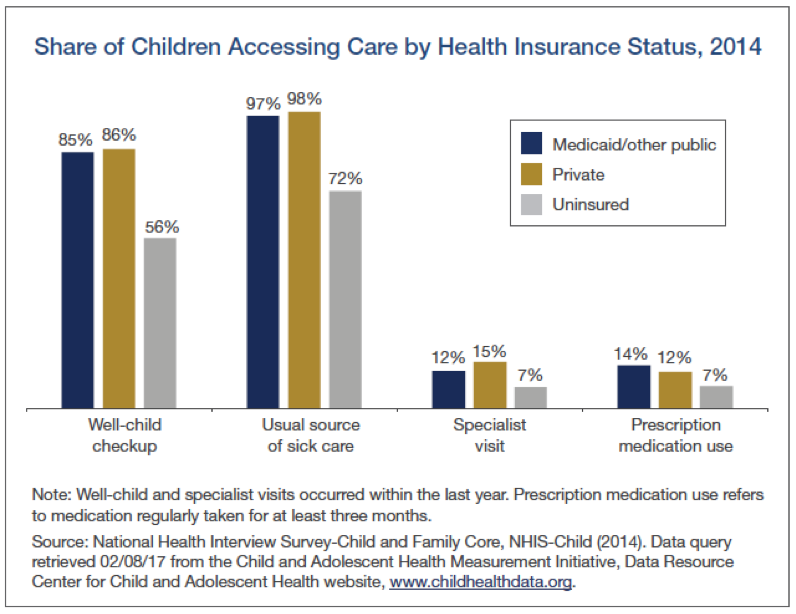
Our new fact sheet summarizes research on access to care in Medicaid. We find that children and parents who rely on Medicaid for health care receive coverage that is comparable to private insurance and far better than the access accorded uninsured families. Children covered by Medicaid and those with private insurance access health care services…
-
Arizona Medicaid Waiver Amendment Does Not Include Analysis of Impact on Budget and Individuals
Arizona will shortly be submitting an amendment to its existing Section 1115 waiver that includes some very major and unprecedented changes to its Medicaid expansion such as the imposition of a work requirement (which has to be verified on a monthly basis!), and a five-year life- time limit on Medicaid benefits. The state also seeks…
-
7 Questions Congress Should Answer Before Messing with Medicaid
Ok, all you Schoolhouse Rock fans, let’s sing along: “I’m just a Bill. Yes, I’m only a Bill. And I’m sitting here on Capitol Hill. Well, it’s a long, long journey to the Capital City It’s a long, long wait while I’m sitting in committee.” That was true in 1976, when Bill made his debut.…
-
Top Five Ways ACA Repeal and Medicaid Financing Changes Would Harm our Youngest Children
Editor’s note: We at Say Ahhh! are getting a lot of traction around our “top 5s” on Medicaid cuts and the impact of ACA repeal and Medicaid financing changes on child welfare. So we thought we should continue the trend and focus on young children. We are grateful our colleagues at CLASP agreed to join…
-
CHIR Expert Testifies Before the House Committee on Small Business Regarding Enhancements to the ACA
By Emily Curran and Dania Palanker, originally posted on CHIRblog On February 7, the House Committee on Small Business held a hearing titled, “Reimagining the Health Care Marketplace for America’s Small Businesses,” to discuss the challenges small businesses are facing in the health insurance marketplaces and to offer potential solutions for the next phase of…
-
Nation’s Success in Covering Children is in Peril
House Republicans recently released an outline of their plans to repeal and replace the Affordable Care Act and today an earlier version of the bill they were drafting was leaked. While the leaked bill is likely an old draft, both of these documents confirm what I have suspected was coming — while repealing and replacing…
-
Radically Restructuring Medicaid Would be Bad for Kids
While most press coverage has focused on repealing the Affordable Care Act and scaling back the Medicaid expansion for adults, a less well-known but extremely damaging effort under consideration by Congress would radically restructure Medicaid financing. Proposals would do this through a block grant or per capita cap designed to save money by limiting federal contributions. (Kaiser just put…
-
Growth In Medicaid Spending Per Enrollee Is Low
A new fact sheet from the Commonwealth Fund, “Essential Facts About Health Reform Alternatives: Block Granting Medicaid,” makes compelling arguments about the dangers of block granting Medicaid. States would receive a fixed, preset amount of federal funds that would not change if the number of enrollees increase or if the cost of services rise. This…
-
State Snapshots of Children’s Health Coverage
As Say Ahhh! readers well know, Medicaid and CHIP are a primary source of coverage for children, particularly the most vulnerable children. But even people who know the importance of our public coverage programs are often surprised to learn key statistics about Medicaid and CHIP. For example, did you know that: 57 percent of all…
-
Congress Must Act Quickly on CHIP
As regular readers of SayAhhh! know, funding for the Children’s Health Insurance Program (CHIP) will expire on September 30, 2017. Medicaid and CHIP have worked together to bring the nation’s uninsurance rate for children down to a historic high of 95%. Whether the country will continue moving forward on this critical question is a key…
-
TANF, CCDBG Demonstrate That Block Grants And Per Capita Caps Won’t Work For Medicaid
By Suzanne Wikle and Jessica Gehr of CLASP Congress is reportedly again considering proposals to change the fundamental structure of Medicaid, including by turning it into a block grant program or providing fixed allotments per recipient (“per capita caps”). Such proposals have been made repeatedly over the years, but consistently rejected. However, other programs with…
-
Arizona is Trying to Impose a Lifetime Cap on Medicaid Coverage
By Jesse Cross-Call, Center on Budget and Policy Priorities Arizona will soon send a proposal to the federal government to place a five-year lifetime limit on Medicaid coverage for adults under 65 who don’t have a disability. The government should reject the proposed time limit, which would lead to coverage losses and increase hardship among older, low-income…
-
Cutting Medicaid Would Hurt Public School’s Efforts to Improve Student Success
The School Superintendent’s Association just released a survey documenting the concerns that superintendents and other school leaders have about Congressional plans to cut Medicaid spending. CCF spoke with Sasha Pudelski, author of the report Cutting Medicaid: A Prescription to Hurt the Neediest Kids, about the impact Medicaid cuts would have on students and schools. Can…
-
Affordable Care Act Repeal Efforts Would Impact State Laws, Too
By Kevin Lucia and Katie Keith, originally posted on CHIRblog With much of the attention over ACA repeal efforts focused on Washington DC, it’s easy to forget that repeal-and-replacement efforts would significantly affect state approaches to insurance regulation. This is especially true in the 32 states and D.C. that have adopted state-level ACA protections. While…
-
Risky Business: Health Actuaries Assess the Individual Market and Rates
By Rachel Schwab, originally posted on CHIRblog Health reform is often a series of what-ifs. As we wade into the uncertainty of congressional action, Executive Orders, and “the greatest replacement plan ever,” consumers and insurers alike have to hedge their bets and carefully calculate the impact of a number of unknown outcomes. Unfortunately sometimes it…
-
Georgetown CCF Welcomes National Medicaid Expert Andy Schneider to our Team
It is with great pleasure that I am able to share some wonderful news with SayAhhh! readers about the latest addition to our team here at Georgetown University’s Center for Children and Families. For Medicaid cognoscenti, Andy Schneider needs no introduction as there are few individuals who are more integral to the development of the Medicaid…
-
ACA Repeal & Medicaid Cuts Would Make it Tougher for Arkansas to Meet Education Goals
Last month, Arkansas Gov. Asa Hutchinson vowed to make third-grade reading a top priority, building on the impressive work the state has already done to bring more children into early education programs. Now the federal push to scrap the Affordable Care Act (ACA) and change the way we provide health care to families threatens to…
-
Uncertain Future for the Affordable Care Act Leads Insurers to Rethink Participation, Prices
By Sabrina Corlette, Kevin Lucia, Justin Giovannelli and Dania Palanker, originally posted on CHIRblog The Affordable Care Act (ACA) is facing an uncertain future, with a new President and Congress committed to its repeal. Upcoming policy debates could have a dramatic impact on the individual health insurance market, especially the ACA’s marketplaces. While millions of…