Oregon
-
Uninsured Rate for Young Children Rose More Sharply than for Older Children from 2022-2024
Key Findings The number of infants, toddlers and preschoolers who are uninsured is at the highest level in nearly a decade and is increasing more sharply than for older children. The number of uninsured children under age 6 grew by 23% between 2022 and 2024, while the number of uninsured school-aged children grew by 17%. The charts and appendix…
-
Tracking Oregon Implementation of H.R. 1 Medicaid Work Reporting Requirements
Medicaid Enrollment Trends The CCF Enrollment Tracker uses the most recent monthly administrative data from state websites and the Centers for Medicare & Medicaid Services (CMS). State administrative data is often the quickest way to assess what is happening in a state’s Medicaid program. Oregon is one of 16 states where only CMS data –…
-
Is Your State Leaving Money on the Table? How CHIP Health Service Initiatives Can Help States Support Children’s Access to Care
At a time when states are facing growing fiscal pressures and increasing strain on health systems, the Children’s Health Insurance Program (CHIP) Health Services Initiatives (HSIs) represent an often overlooked source of federal funding offering flexible financing to support outreach and targeted health initiatives to improve children’s health. This source of federally-matched funding becomes increasingly…
-
Maternal and Infant Health in State Rural Health Transformation Proposals Set Promising Priorities in an Uncertain Landscape
All 50 states applied for CMS’ Rural Health Transformation (RHT) program, a $50 billion fund borne from a need to reassure members of Congress during the final debate over H.R. 1 that Medicaid cuts would not decimate their states’ rural health systems. As previous blogs have detailed, the RHT program presents a unique opportunity for…
-
How are H.R. 1 Cuts and Changes to Medicaid and SNAP Playing out in 2026 State Legislative Sessions So Far?
Following the enactment of the largest Medicaid cuts in history, we anticipated a flurry of Medicaid activity in state legislative sessions. State legislators were left to fill the budget holes made by H.R.1, figure out how to implement H.R.1-mandated policies like work reporting requirements, and (hopefully) mitigate some of the associated coverage losses. Ten state…
-
State by State Medicaid and CHIP Enrollment Data
This tracker shows enrollment data for Medicaid and the Children’s Health Insurance Program (CHIP) in all 50 states and DC, from January 2025 to the most recent month available. Data include total Medicaid/CHIP enrollment, as well as enrollment for children, adults, and Medicaid expansion. Historical data are also included to provide additional context for state…
-
Medicaid’s Role in Small Towns and Rural Areas
Key Findings Background One-fifth of people in the United States live in areas that are classified as non-urban. Residents of rural areas and small towns face additional challenges accessing needed health services compared to residents of metro areas for a variety of reasons including acute provider shortages, limited connectivity, and long distances to travel to…
-
CMS Releases Updated Medicaid & CHIP Telehealth Toolkit, Includes State Best Practices and Behavioral Health Strategies
This month, CMS released an updated State Medicaid and CHIP Telehealth Toolkit consolidating information from previous toolkits and providing additional guidance – as required by the Bipartisan Safer Communities Act – on issues from billing best practices to strategies for using telehealth in schools. In addition to FAQs on issues such as benefit flexibility, financing,…
-
State Medicaid and CHIP Snapshots, 2023
The Georgetown University Center for Children and Families (CCF) and the American Academy of Pediatrics (AAP) created factsheets underscoring the importance of Medicaid in providing coverage for children in all 50 states and the District of Columbia. Sources available here. Previous snapshots can be found here (2019), here (2018) and here (2017). Check out more interactive…
-
Expedited CMS Approvals in Washington and Oregon Can Further Minimize Coverage Disruptions, Aid Unwinding
New CMS approvals in Oregon and Washington will protect health coverage for more children and families during this year’s consequential unwinding, minimizing coverage disruptions and easing transitions to new sources of health coverage. Oregon receives approval to ease coverage transitions for certain adults, allowing them to stay in Medicaid until they can transition to alternative…
-
New Data Underscores Need to Catch up on Routine Childhood Vaccinations
The Centers for Disease Control and Prevention (CDC) released updated data on vaccination coverage among kindergartners, showing a continued decline in the share of children with the recommended doses of routine childhood vaccines needed to prevent the spread of harmful diseases. The report includes data on vaccination rates by state for four vaccines: measles, mumps,…
-
Comments on Oregon Bridge Plan Amendments
The Center on Budget and Policy Priorities and the Georgetown University Center for Children and Families submitted these comments to CMS regarding Oregon’s application to amend its “Bridge Plan”. CCF-CBPP Oregon Bridge Plan Amendment Comments
-
Webinar: Medicaid Continuous Eligibility for Children up to age 6 in Oregon
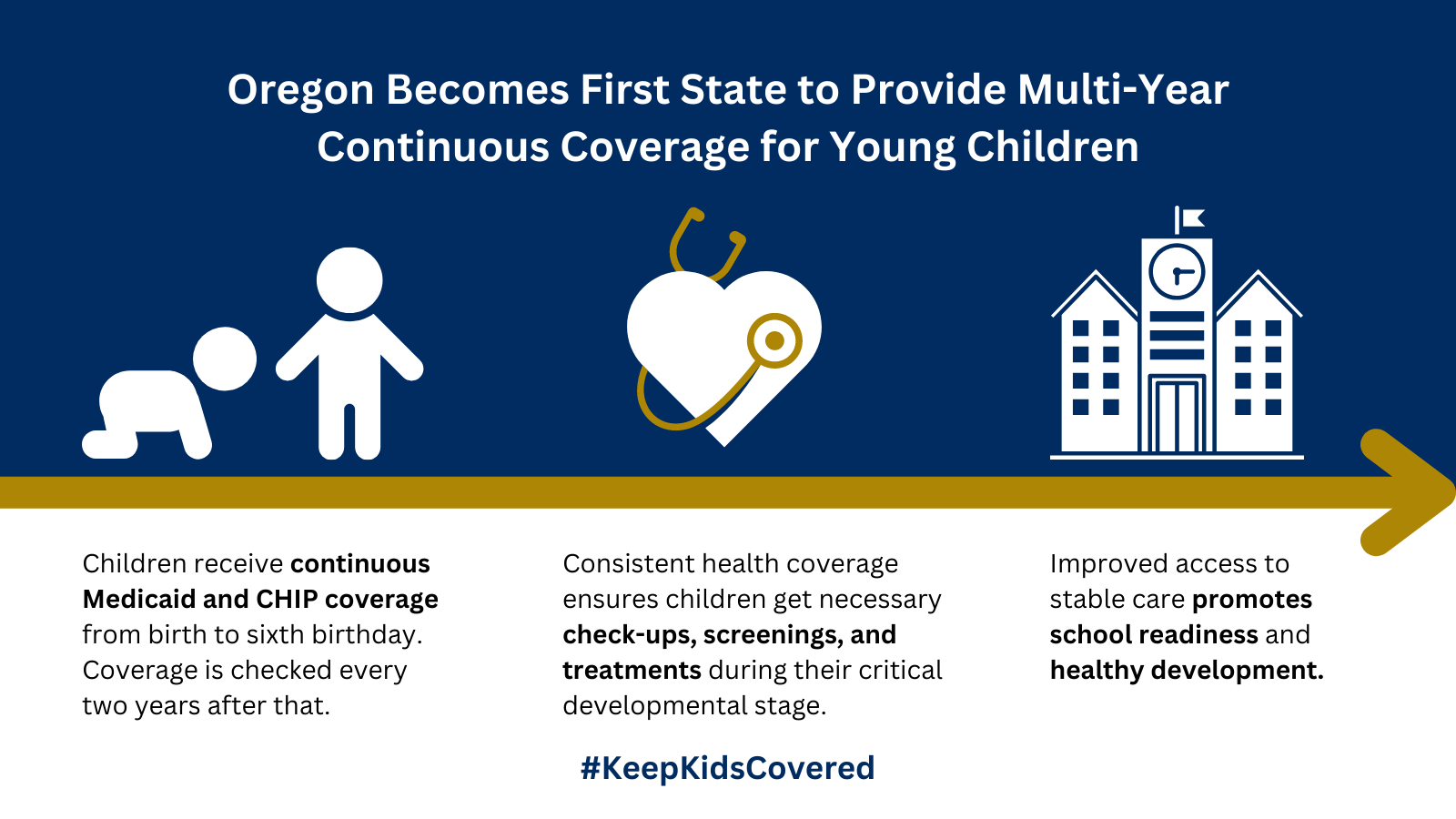
On September 28, CMS approved Oregon’s groundbreaking proposal to provide continuous eligibility (CE) in Medicaid and CHIP for children from birth to age 6 as a component of the state’s school readiness and health care transformation strategies. The approval also creates a two-year CE for all beneficiaries ages 6 and older, along with a number…
-
Oregon Leads the Nation By Covering Children in Medicaid from Birth to Kindergarten – Which State Will Be Next??
The Biden Administration announced today that it will approve Oregon’s request to provide continuous Medicaid coverage to children from birth through age five and for two years for all Oregonians enrolled in Medicaid age six and up. This use of Section 1115 authority is precisely what Medicaid demonstrations are for — as we and colleagues…
-
CMS Approves First State for New ARPA Medicaid Mobile Crisis Services Option, Additional States Express Interest
This week, the Centers for Medicare & Medicaid Services announced approval of Oregon’s plan to cover community-based mobile crisis intervention services for individuals experiencing mental health or substance use crises under a new Medicaid state option. As we’ve previously highlighted on Say Ahhh!, the American Rescue Plan Act (ARPA), passed in March 2021, included a…
-
Oregon’s Waiver Proposal: Continuous Eligibility for Young Children as a School Readiness Tool, But Why Not EPSDT?
As my colleagues blogged last week, Oregon released its 1115 waiver proposal for state public comment, which included precedent-setting concerns and innovations. We were pleased to see multi-year continuous eligibility included—up to five years for children under age 6, and two years for ages 6 and older. While a few states are in various stages…