

Overview
Starting in January 2027, H.R. 1 requires every state that adopted the Affordable Care Act’s (ACA’s) Medicaid expansion to low-income adults (and select additional states) to implement work reporting requirements. These work reporting requirements (WRRs) predominantly affect those enrolled in the Medicaid expansion category—coverage for adults with incomes up to 138% of the federal poverty level ($20,783 for an individual in 2026), who are not covered under traditional categories, such as the state’s mandatory parent/caretaker coverage at lower income levels.
Under any enrollment scenario, pregnant and postpartum enrollees are not subject to WRRs throughout their pregnancy and postpartum period. Most pregnant and postpartum women1covered by Medicaid are not enrolled in a category subject to work reporting requirements. Others are expressly excluded from WRRs during pregnancy and through their postpartum period. However, making these exclusions work in practice will be critical to ensuring eligible pregnant and postpartum women do not mistakenly lose coverage.
While the Centers for Medicare & Medicaid Services (CMS) has issued a WRR rule and guidance for states, important questions remain about how states will ensure pregnant and postpartum women enrolled in Medicaid successfully maintain coverage. How will states correctly identify pregnant or postpartum women in the expansion category and keep them from being subject to WRRs that could interrupt coverage just as they are preparing for birth or caring for a newborn?
The nation already faces a persistent and long-standing maternal health crisis that disproportionally impacts Black, American Indian or Alaska Native, and Native Hawaii or Pacific Islander women, reflecting broader social and economic inequities.2 Medicaid pays for more than four in 10 births3 and more than two-thirds of births among Black and Indigenous women.4 Maternal health leaders at the national and state levels have taken steps to help improve maternal health and address inequities through Medicaid changes, such as extending postpartum coverage from 60 days to 12 months;5 offering coverage for additional community-based providers such as doulas and midwives; and detailing specific expectations of managed care organizations tasked with furnishing care to pregnant6 or postpartum7 Medicaid enrollees. H.R.1 cuts and administrative red tape, including WRRs, risk rolling back on progress if enrollees face interrupted coverage and care.
Medicaid Work Reporting Requirements begin in 2027 for Many Adults – Coverage for Pregnant and Postpartum Enrollees is Protected
The 2025 Budget Reconciliation Law, or H.R. 1, requires states to implement work reporting requirements (WRRs) in Medicaid beginning January 1, 2027 with requirements to notify enrollees beginning in the fall. Several states have announced they will implement the policy early.8 Nebraska9 began May 1, 2026, Montana10 in July 2026 and Iowa will begin in December 2026. Arkansas began a soft launch of their WRRs in July 2026, but no disenrollment’s will occur until January 2027.11
Many studies12 and stories13 from earlier attempts to implement Medicaid work requirements in Arkansas14 and Georgia15 have shown that the policy creates barriers that result in coverage terminations, in some cases even after meeting the paperwork requirements to demonstrate exclusions or report work hours. The potential loss of coverage is especially concerning for pregnant and postpartum enrollees, who already face significant health care risks amid a continued U.S. maternal mortality16 and morbidity17 crisis disproportionally impacting Black and Indigenous mothers. While H.R. 1’s WRR mandate excludes pregnant and postpartum mothers whose births were covered by Medicaid, the reality will be more complicated and require that states take intentional steps to protects their coverage.
Under H.R.1, WRRs apply to adults ages 19 to 64 enrolled in Medicaid expansion category of coverage in the 40-plus states that have expanded coverage to low-income adults through the Affordable Care Act (ACA) or have partially expanded Medicaid through Section 1115 demonstration waivers that provide Minimum Essential Coverage for a similar population.18A June 2026 interim final rule from the federal Medicaid agency adds detail to groups who are not subject to WRRs.19
Among those the WRRs do not apply to include:
- Pregnant women covered under the federal mandatory coverage category (at least 133% FPL), as well as those covered in the category at higher, state-optional income levels.
- People enrolled in other traditional Medicaid categories, such as low-income parents or people qualifying for Medicaid based on disability or the need for long-term care.
- People receiving only family planning services.
To keep their Medicaid coverage, people in Medicaid expansion (see Box 1 below) subject to work requirements must:
- Qualify for an exclusion, such as being pregnant or postpartum, caring for a child under age 14, or having certain health conditions;
- Have household income of at least $580 per month or average that much as a seasonal worker;
- Work, participate in work training programs, or do community service for at least 80 hours per month, or do any combination of these activities for 80 hours; or
- Attend an approved educational program at least half time (less than half time school can be combined with other activities toward the 80 hours).
Under any enrollment scenario, pregnant and postpartum enrollees are not subject to WRRs throughout their pregnancy and postpartum period (12 months following the end of pregnancy in 49 states and D.C). But making these exclusions work in practice will be critical to ensuring eligible pregnant and postpartum women do not mistakenly lose coverage.
BOX 1: What is Medicaid Expansion?
Medicaid expansion is a type of Medicaid coverage created by the ACA. Before the ACA, Medicaid was largely limited to specific groups of low-income people including: children, pregnant women, parents, older adults, and people with disabilities.
The ACA allowed states to cover all adults to age 65 with incomes at 138% of the federal poverty level (about $20,783 for an individual in 2026) starting in 2014, regardless of whether they are pregnant, have children, or experience disabilities. As of 2026, 40 states and Washington, D.C., have adopted Medicaid expansion.20 The federal government pays a higher share of costs for people in the Medicaid expansion coverage category (90% federal medical assistance percentage, or FMAP) compared to traditional Medicaid categories (FMAP varies by state and territory, ranging from 50 to 83% in 2026).21
How are Pregnant Women Covered in Medicaid?
Pregnant women with Medicaid may be enrolled in one of several possible categories, most of them based on income.22
- Pregnancy Category: Medicaid income eligibility specifically for pregnancy, ranges from 138% to 324% of FPL depending on the state, with a median of 213% of poverty.23 Pregnant individuals in this category are not subject to work requirements under H.R. 1.
- Low-Income “Section 1931” Parents and Caretaker Relatives: Traditional Medicaid for parent/caretaker coverage, typically covering only those with very low incomes. As of January 2026, income eligibility for Section 1931 parents24 ranges from 12% to 138% FPL with a median of 36% FPL25 Parents in this category are not subject to work requirements under H.R. 1. A parent enrolled in this category may become pregnant.
- Medicaid Expansion: Provides coverage for adults with incomes up to 138% of poverty. States may, but are not required to, move pregnant enrollees to the pregnancy category. Many women who are enrolled in the expansion group before they become pregnant may remain in the category for the duration of their pregnancy and postpartum period. Enrollees in the expansion category who are pregnant or postpartum are specifically excluded from WRRs under H.R. 1,meaning they are not considered “applicable individuals” subject to WRR and do not need to demonstrate work, volunteering, or school activities as a condition of eligibility.
- Other Categories: Includes coverage for other people who may become pregnant including: children under age 19, people who qualify on the basis of disability (e.g., those who are eligible for Supplemental Security Income, or SSI), former foster youth under age 26, and other specific groups determined by specific circumstances or health conditions.
Based on 2022 data (the most recent available), more than two-thirds of pregnant women covered by Medicaid in expansion states were enrolled in categories that are automatically excluded from work reporting requirements. As shown in Figure 1, at the time of birth most pregnant women were enrolled in the pregnancy or low-income parent groups.26,27
But that still leaves nearly 16% of pregnant women nationally enrolled in the Medicaid expansion. The share varies by state, with more than a third of pregnant women in Montana (43%), Louisiana (39.9%) an Kentucky (35%) in the expansion category at the time of birth.28 Even as a smaller share, the numbers are notable and meaningful in the context of H.R. 1. The 16% of pregnant enrollees in expansion category translates to more than 135,000 people nationally, ranging from about 100 expansion enrollees in Rhode Island to more than 20,000 in California.29
If Medicaid covers pregnant women through a pregnancy pathway, why are some enrolled in the Medicaid expansion? The ACA’s Medicaid expansion to low-income adults allowed more women of reproductive age to have consistent coverage before, during, and after pregnancy, including those who may become pregnant for the time. Multiple studies have shown links30 between states expanding Medicaid and improved maternal health care access, lower maternal mortality rates31and better birth outcomes.32 Coverage could mean the difference between a pregnant or postpartum women getting her health care needs addressed before she becomes pregnant instead of bringing unmet health conditions to a pregnancy that could add complications and additional risk to both mother and infant health.33 The Urban Institute found that more than half of pregnant women enrolled in the Medicaid expansion category during the month of delivery had a chronic physical and/or behavioral health condition, including more than 40% with a mental health condition.34
12-Month Postpartum Coverage: A New Option with Rapid Uptake Shows State Commitment to Maternal Health
Through the 2021 American Rescue Plan Act, Congress gave states the option to extend Medicaid postpartum coverage to pregnant enrollees from 60 days to 12 months starting in April 2022.35 As a condition of taking the option, states must ensure continuous enrollment for pregnant women in nearly every category of Medicaid or the Children’s Health Insurance Program (CHIP)—including expansion—with full benefits through pregnancy until the end of the 12th month following the end of pregnancy. As of 2026, every state except Arkansas has adopted the postpartum extension to 12 months.36 This means pregnant women should not have their Medicaid eligibility redetermined during that period. It also lays important groundwork to maintain coverage for pregnant and postpartum enrollees in the expansion category (see Box 2 below).
The 100,000+ pregnant or postpartum women enrolled in Medicaid expansion, and even those enrolled in other Medicaid categories, may learn about new WRRs and become confused about their responsibilities. States need to be extremely clear about the processes in places to ensure these women know they are not subject to WRRs and, for expansion enrollees, the easiest way to inform the state about their pregnancy.
The Central Challenge: Identifying Pregnancy Among Medicaid Expansion Enrollees to Protect Them from WRRs, Incorrect Disenrollment
Making sure each pregnant woman enrolled in Medicaid is appropriately excluded from WRRs will require dedicated state attention to process and ongoing oversight.
The key question is: How will the state identify when someone enrolled in Medicaid expansion is pregnant or postpartum to avoid the added burden of work reporting requirements?
At Medicaid Application:
Pregnancy Self-Attestation: When someone applies or renews Medicaid and claims they are pregnant, federal rules require states to accept the self-attestation, or a statement of pregnancy, without requiring additional documentation unless the state has conflicting information.37 If the person meets income and other eligibility requirements, states will enroll them in the pregnant women category on the basis of pregnancy.
Under the interim final rule implementing WRRs, CMS reiterated that states must accept self-attestation of pregnancy or entitlement to postpartum Medicaid unless the state has information inconsistent with the attestation.
Individuals can report also pregnancy as a change in circumstances after enrollment or at renewal—and states should use this information in their eligibility systems to determine that a woman is specifically excluded from WRR. In addition, at renewal, states may use claims data, encounter data, health records, or other reliable information available to the state when determining if enrollees in Medicaid expansion coverage are now newly excluded because they are pregnant or postpartum.
When Pregnancy Occurs During Enrollment in Medicaid Expansion:
Things become more complex for Medicaid expansion enrollees who become pregnant. If an individual is eligible for more than one category of Medicaid, states must allow individuals to select their eligibility category.38 A pregnant woman with income under 138% of poverty may choose to move to pregnancy coverage. States are not required to monitor whether people in Medicaid expansion become pregnant or to move them into pregnancy coverage.39 States only have to:
- Inform people about their coverage options
- Change someone’s category if they request it and are eligible
If a state is not aware of an expansion enrollee’s pregnancy, how will the agency know to exclude them from WRRs and to ensure that they are continuously enrolled until the end of the postpartum period? Claims data may show this, but there is a lag time before the data becomes available.
Medicaid Enrollment and Renewal Processes May Leave Room for Error Among Pregnant and Postpartum Enrollees
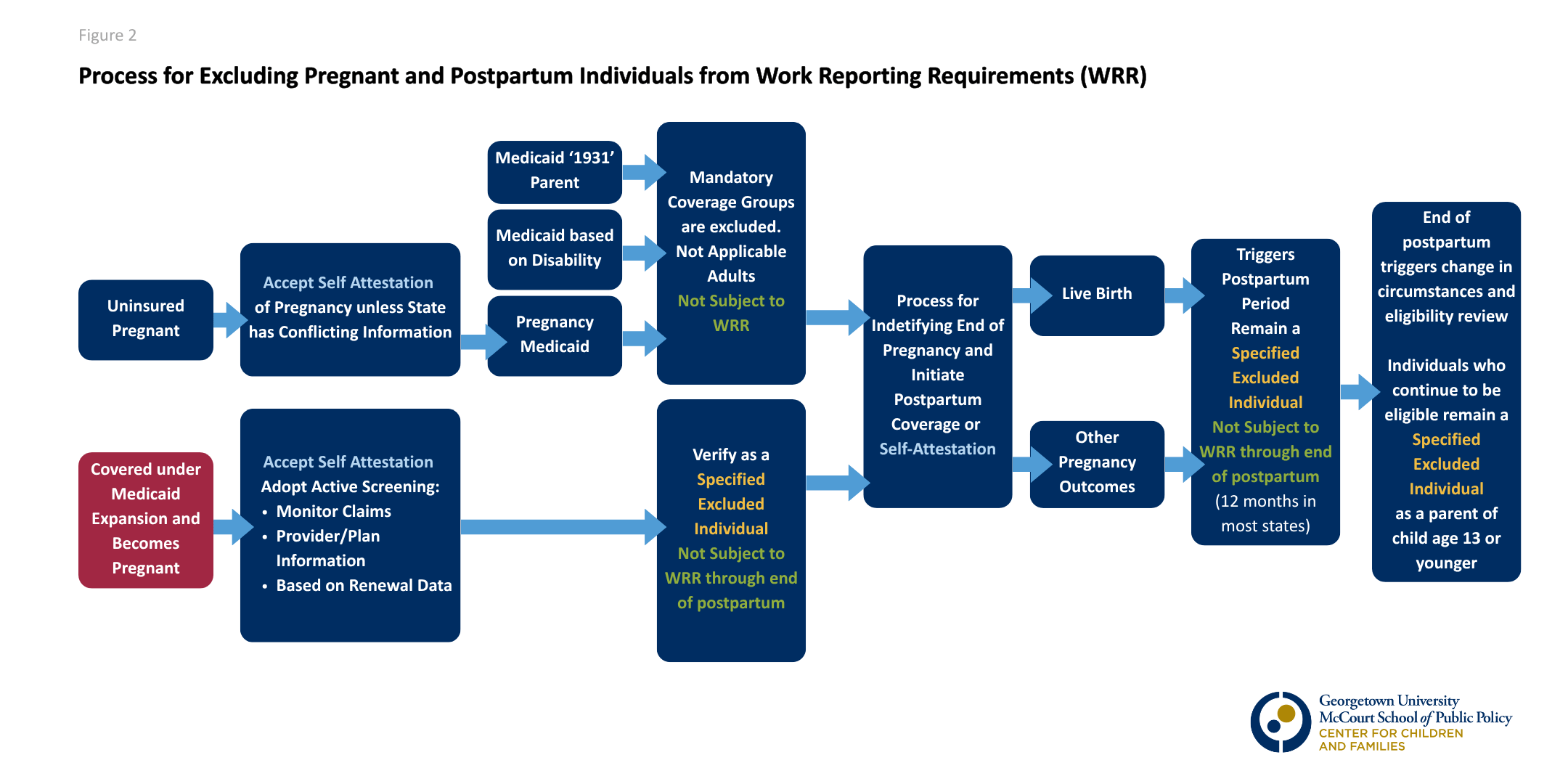
Because women may be enrolled in Medicaid expansion before they become pregnant, a key challenge is identifying the pregnancy between renewals if they are enrolled in the expansion category. Figure 2 below illustrates the complexities of enrollment and WRR exclusions, noting the places pregnant or postpartum enrollees could fall through the cracks and become uninsured without careful attention.
Even if a pregnancy was not identified during the prenatal period, states should have mechanisms to flag postpartum enrollees at the end of pregnancy. (This may be done in parallel to the requirement for automatic newborn enrollment and 12-month continuous coverage for infants.40,41) If every state adopting the 12-month postpartum extension is implementing the measure successfully, WRR exclusion for a postpartum enrollee should be added to the Medicaid file. While a postpartum woman with a newborn also qualifies for WRR exclusion as a parent of a child under age 14, the postpartum exclusion ensures uninterrupted coverage through the 12 months following the end of a pregnancy in states with the full extension.42
BOX 2: Extended Postpartum Coverage Maintains Stable Coverage through 12 Months Postpartum Period for Pregnant Enrollees in 49 States and D.C.
As of 2026, every state except Arkansas has adopted43 postpartum extension to 12 months. State implementation of postpartum extension may have laid important groundwork to identify pregnant women in the expansion category more quickly.44
Pregnant and postpartum women are excluded from work reporting requirements under H.R. 1. In addition, federal guidance requires states to treat the 12-month postpartum period as automatic and continuous eligibility, with no redeterminations of eligibility before the 12 months end. But it is not clear exactly how state processes ensure coverage throughout the extended postpartum period, which may create another layer of complexity with H.R. 1 WRR rules:
- How do states identify when someone in the Medicaid expansion category is pregnant or postpartum to ensure uninterrupted enrollment through the end of the 12-month postpartum period?
- How are postpartum women automatically enrolled in 12-month continuous coverage without redetermination?
- H.R. 1 requires that states review Medicaid eligibility for the expansion population every six months, but pregnancy plus postpartum may last up to 21 months. How do these timelines work together?
- Does a Medicaid-financed birth trigger an automatic extension of the eligibility period and date of next redetermination to a full 12 months after a birth or end of pregnancy?
State Strategies to Identify Pregnant and Postpartum Enrollees for WRR Exclusions
Every state’s Medicaid eligibility system and processes are unique, but generally, states have several ways to identify and effectively protect pregnant and postpartum women from WRRs, dependent on system capabilities and oversight capacities. As discussed in more detail in a recent analysis by the Urban Institute,45 states may adopt one or more of the system changes below, ideally in a combination that is designed to place the least burden on the majority of enrollees.
Since none of the options outlined below will by itself meet circumstances for every applicant or enrollee, it will be important for states to employ multiple strategies to identify and protect each pregnant or postpartum mother enrolled in expansion coverage.
1. Self-Attestation – An Applicant or Enrollee’s Claim of Pregnancy at Regular Screening Touchpoints
The federal Medicaid interim final rule on WRR makes clear that states must accept an enrollee’s claim of pregnancy or postpartum status, unless the state has information inconsistent with the statement. States should ensure enrollees have a well-structured process in person and/or online to inform the state that they’re pregnant or postpartum. The state, in turn, accepts their declaration as self-attestation without need for further verification whether at application or renewal.
Individuals can report pregnancy when they apply, as a change in circumstances after enrollment or at renewal. When enrollees renew their Medicaid coverage (every six months for expansion enrollees if a pregnancy has not yet been identified), the state asks if they’re currently pregnant or postpartum. States should use this information in their eligibility systems to determine exclusion from WRRs. The state is not allowed to terminate an enrollee for noncompliance under such a pregnancy self-attestation.
Advantages:
- Less burdensome than requiring documentation from enrollee and/or provider
- Protects privacy—enrollees don’t have to provide medical records
- Consistent with Medicaid eligibility rules
- Systematic—catches people at a regular checkpoint
- Respects privacy—people only report if they choose to do so
- A more proactive opportunity to determine pregnancy or postpartum status, rather than waiting for claims data that may be delayed (see #2 below)
Challenges:
- Requires women to know they need to report their pregnancy
- Only happens twice a year—could miss people who become pregnant between renewals
- Effectiveness and use depend on mechanisms set up by state (e.g., easy to use Internet portal)
- Pregnancy and postpartum together last longer than six months, creating potential timing mismatches and potentially interruption in coverage if self-attestation is the only option to verify pregnancy or postpartum
2. Use Available Electronic Data to Automate Exclusions (“Ex Parte”)
States should use billing codes from claims data and/or diagnosis codes from providers and/or managed care organizations contracting with Medicaid to automatically identify when someone is pregnant (e.g., receiving prenatal care) or had a Medicaid-financed birth.
Advantages:
- Automatic—doesn’t require pregnant or postpartum women to do anything
- State already has access to this information
- Ongoing process that is consistently and actively identifying pregnancy and postpartum status among enrollees
Challenges:
- Delay—claims data can take weeks or months to process and/or be transmitted to the state
- January 2027 adoption of new billing codes for maternity care 46,47 —including prenatal, birth, and postpartum care—may make implementation more administratively complex
- Privacy concerns
3. Provider Notification
Doctors, hospitals, or health plans notify the state when they confirm a patient is pregnant or when a Medicaid financed birth occurs.
Advantages:
- Could be faster than waiting for billing data
- Involves health care providers who already know about the pregnancy
- Consistent with presumptive eligibility and other eligibility processes in many states under which provider confirms pregnancy or birth (e.g., automatic and continuous infant coverage requirement for Medicaid-financed birth)
Challenges:
- May require building new systems and processes if not currently used
- Adds burden for health care providers and enrollees
- May have inconsistent reporting from providers, requiring the strategy to be done on top of self-attestation, data automation, and screening
Key Questions for States to Protect Pregnant/Postpartum Enrollees from Losing Health Coverage Due to Work Reporting Requirements
As maternal and child health advocates, community leaders and others monitor and seek to influence state implementation and ongoing improvements to H.R.1 Medicaid WRRs, the questions below offer a guide. Answers to these questions can help to inform a range of stakeholders on the processes and strategies their state will use to protect coverage for pregnant and postpartum women enrolled in Medicaid.
Outreach and Education
CMS rulemaking makes clear state responsibilities to educate enrollees about WRRs, including exclusions.
- What methods will the state use to conduct outreach and education to Medicaid enrollees about WRRs and the required exclusions?
- What kind of self-help resources48 will the state have available to support pregnant and postpartum enrollees?
- In what specific ways will the state reach out to pregnant and postpartum enrollees or applicants to assure them of WRR exclusion?
- How will the state ensure notices and public education materials are understandable and translated into languages that reflect the full range of Medicaid enrollees?
- What providers, agencies, and community-based organizations will the state partner with to help ensure the correct information gets out about WRR exclusions?
- What resources and training will the state provide to community-based partners and providers to ensure enrollees can rely on trusted messengers for timely, accurate information?
Pregnancy and Postpartum Identification
- How will the state systems identify whether people already enrolled in the expansion group become pregnant or are in the postpartum period to process WRR exclusions?
- Where in the state enrollment file can the agency flag someone’s file as ‘pregnant’ or ‘postpartum’ when they’re in the ACA expansion coverage category?
- If the state learns an enrollee in the expansion category is pregnant or postpartum, what process will be used to ensure their file is flagged for exclusion through the full 12-month postpartum period?
- What mechanisms will the state use to identify those who had a Medicaid-financed pregnancy or birth to ensure WRR exclusion? How will the state ensure the 12-month postpartum period lines up with the infant’s 12 months of continuous coverage?
- How will the state identify when someone in ACA expansion category is in their 12-month postpartum period?
- How will the Medicaid agency confirm postpartum status prior to or as part of a renewal for expansion enrollees to ensure the redetermination date is moved to a full 12 months following the end of a pregnancy?
- If someone’s income changes during their postpartum period and their postpartum status has not yet been identified, how will the state take steps to ensure they maintain postpartum coverage for the full 12 months along with the WRR exclusion?
Systems and Data
- What systems are in place to ensure that all adults covered in the pregnancy, low-income parent, and other non-expansion categories are not subject to WRRs as required by law?
- How will the state access medical claims and other data to automatically identify pregnancy or postpartum status? How quickly can that data be processed and securely passed along to the eligibility system to mark the exclusion?
- How will the state keep health information safe to protect the privacy of each enrollee?
- Will the state allow for health care providers to report pregnancy status? How will providers be made aware and trained on the new system?
Conclusion
Medicaid expansion covers millions of low-income adults, including many pregnant or postpartum women and women of reproductive age. Medicaid WRR implementation raises substantial risks to coverage for pregnant and postpartum women during a period of family change and rapid early childhood development when continuous access to health care is crucial. While H.R.1 provides clear exclusions for pregnancy and postpartum women (among many others), making these exclusions work in practice will require state care and attention. Existing mechanisms may not be sufficient to avoid confusion and disruption in coverage for those who become pregnant while enrolled in the expansion, particularly during their postpartum period.
Without explicit consideration to identify and protect coverage, pregnant and postpartum women could inappropriately lose health coverage. At a minimum, states should track exclusions and disenrollments to monitor the degree to which these women may fall through the cracks.
Protecting Medicaid coverage for pregnant and postpartum enrollees requires careful system design, active stakeholder engagement, and ongoing monitoring for continuous improvement. Most importantly, it requires states to prioritize pregnant and postpartum women, parents, and their families as they implement work reporting requirements.
Additional CCF Resources
- New Federal Medicaid Work Reporting Requirements Rule Threatens Coverage for Vulnerable Americans: An Explainer of the Interim Final Rule
- Tracking Implementation of H.R. 1 Work Reporting Requirements, including state-specific pages
Endnotes
- Editor’s note: To maintain accuracy, Georgetown CCF uses the term “women” when referencing statute, regulations, research, or other data sources that use the term “women” to define or count people who are pregnant or give birth. Where possible, we use more inclusive terms in recognition that not all individuals who become pregnant and give birth identify as women. ↩︎
- “Data from the Pregnancy Mortality Surveillance System,” (Centers for Disease Control and Prevention, December 18, 2025), available here ↩︎
- U. Ranji, et al., “5 Key Facts About Medicaid and Pregnancy,” (KFF, May 29, 2025), available here ↩︎
- L. Hill, et al. “Racial Disparities in Maternal and Infant Health: Current Status and Key Issues,” (KFF, December 3, 2025), available here ↩︎
- “Medicaid Postpartum Coverage Extension Tracker,”(KFF, March 19, 2026), available here ↩︎
- S. Rosenbaum, et al., “The Road to Maternal Health Runs Through Medicaid Managed Care,” (Commonwealth Fund, May 22, 2023), available here ↩︎
- A. R. Markus et al., “Fortifying Medicaid Managed Care for Postpartum Enrollees: The Clearest Path to Improving Maternal Health, (Commonwealth Fund, January 27, 2026), available here ↩︎
- “Tracking Implementation of H.R. 1 Medicaid Work Reporting Requirements,” (Georgetown UniversityCenter for Children and Families, 2026), available here ↩︎
- “Work Requirements,” (Nebraska Department of Health and Human Services, 2026), available here ↩︎
- “Changes to Medicaid,” (Montana Department of Public Health and Health Services, June 30 2026), available here ↩︎
- “Welfare to Work Requirement Rollout Begins July 1” (Arkansas Office of the Governor, June 26, 2026, available here ↩︎
- L. McCormick, “New Research on Medicaid Work Requirements Highlights the Importance of State Policy Choices,” (Prenatal-to-3 Policy Impact Center, June 24, 2026), available here ↩︎
- L Harker, “Pain But No Gain: Arkansas’ Failed Medicaid Work-Reporting Requirements Should Not Be a Model,” (Center on Budget and Policy Priorities: August 8, 2023), available here ↩︎
- B.D. Summers et al., “Work Requirements in Arkansas: Two-Year Impacts on Coverage, Employment, and Affordability of Care,” Health Affairs 39, no. 9 (September 8, 2020), available here ↩︎
- J. Alker. CMS’s Georgia Waiver Extension Underscores the Failure of Medicaid Work Requirements,” (Georgetown University Center for Children and Families, October 30, 2025), available here ↩︎
- E. Declercq and L. C. Zephyrin, “Maternal Mortality in the United States, 2025,” (Commonwealth Fund, July 2025), available here ↩︎
- E. Declercq and L. C. Zephyrin. “Beyond Maternal Mortality: How Severe Morbidity Reveals Policy Gaps in Maternal Care,” (Commonwealth Fund, June 2026), available here ↩︎
- E. Park and S. Corlette, “Medicaid, CHIP, and Affordable Care Act Marketplace Cuts and Other Health Provisions in the Budget Reconciliation Law, Explained,” (Georgetown University Center for Children and Families, July 22, 2025), available here ↩︎
- Center for Medicare and Medicaid Services. “Medicaid Program; Community Engagement Requirement for Certain Individuals,” (US Department of Health and Human Services, June 3, 2026), available here. ↩︎
- “State Medicaid Expansion Decisions” (KFF, May 21, 2026) available here ↩︎
- “Federal Medical Assistance Percentage (FMAP) for Medicaid and Multiplier” (KFF, 2026) available here ↩︎
- S. H. Gordon et al., “Medicaid Eligibility Category among Enrollees with Medicaid-Paid Births in 2018.” Health Services Research 61, no. 1 (November 2025): e70053, available here ↩︎
- T. Brooks et al., “Medicaid and CHIP Eligibility, Enrollment, and Renewal Policies as States Prepare for Major Medicaid Policy Changes,” (KFF and Georgetown University Center for Children and Families, April 30, 2026), available here ↩︎
- J. Alker and A. Kohler. “Which Parents Will be Impacted by Medicaid Work Reporting Mandate?” (Georgetown University Center for Children and Families, April 2, 2026), available here ↩︎
- Brooks, op.cit. ↩︎
- L.B. Smith et al., Ensuring Continuous Coverage for Pregnant and Postpartum Medicaid Enrollees Under OBBBA. (Urban Institute, March 19, 2026), available here. ↩︎
- E.W. Burak. “New Report Highlights State Data, Strategies to Protect Pregnant and Postpartum Women from Losing Medicaid Coverage Due to Red Tape,” (Georgetown University Center for Children and Families, April 1, 2026), available here ↩︎
- Smith, op.cit. ↩︎
- Ibid. ↩︎
- “How Medicaid Supports Maternal and Infant Health,” (Georgetown University Center for Children and Families, February 2, 2025), available here ↩︎
- E. L. Eliason, “Adoption of Medicaid Expansion Is Associated with Lower Maternal Mortality.” Women’s Health Issues 30, no. 3 (February 2020): 147-152, available here ↩︎
- M.Bellerose et al., “The ACA Medicaid Expansion and Perinatal Insurance, Health Care Use, And Health Outcomes: A Systematic Review.” Health affairs, 41, no. 1 (January 2022): 60-68. available here ↩︎
- E. F. Gregory et al., Preconception and Prenatal Medicaid Coverage for Medicaid-Insured Births,” Journal of Women’s Health, 34, no. 11 (November 2025): 1331-1338, available here ↩︎
- Smith, op.cit. ↩︎
- E. Park and S. Corlette, “American Rescue Plan Act: Health Coverage Provisions Explained,” (Georgetown University Center for Children and Families, March 11, 2021), available here ↩︎
- “Medicaid Postpartum Coverage Extension Tracker,”(KFF, March 19, 2026), available here ↩︎
- “Verification Requirements: Verification of other non-financial information,” (42 CFR 435.956), available here ↩︎
- “Applicant’s choice of category,” (43 CFR 435.404), available here ↩︎
- “Implementation Guide: Medicaid State Plan Eligibility Groups – Mandatory Coverage Pregnant Women,” (MACPro Review Unit for 42 CFR 435.116) available here ↩︎
- “Implementation Guide: Medicaid State Plan Eligibility Deemed Newborns,” (MACPro Review Unit for 42 CFR 435.117), available here ↩︎
- “Deemed newborn children” (42 CFR 435.117), available here ↩︎
- “Medicaid Program; Community Engagement Requirement for Certain Individuals” (Department of Health and Human Services Centers for Medicare & Medicaid Services, Interim Final Rule, [CMS-2454-IFC], Federal Register, 91 no. 106 (June 3, 2026): 33348-33480, available here ↩︎
- “Medicaid Postpartum Coverage Extension Tracker,”(KFF, March 19, 2026), available here ↩︎
- R. Buskey et al., State Strategies to Strengthen Perinatal Health Care Systems and Postpartum Care, (National Academy for State Health Policy, May 11, 2026) available here ↩︎
- Smith, op.cit. ↩︎
- “CPT® 2027 Maternity Care Services code changes,” (American Medical Association, June 12, 2016), available here ↩︎
- “After Years of ACOG Advocacy, AMA Releases New Codes,” (American College of Obstetricians and Gynecologists, April 23, 2026), available here ↩︎
- T. Brooks et al., “Maximizing the Use of Self-Help Resources Should Be a Priority as HR 1 Policies Are Implemented,” (Georgetown University Center for Children and Families, January 29, 2026), available here ↩︎
Acknowledgements: The authors thank Tricia Brooks, Adriana Kohler, and Leo Cuello of CCF as well as Madeline Morcelle of the National Health Law Program for substantial input and review. Joan Alker, Anne Dwyer and Phyllis Jordan also provided helpful reviews.