

As awareness has grown about the new Medicaid work reporting requirements (WRRs) that have already been put in place in some states but are mandated to begin January 1 of next year, it has created layers of confusion about who will be required to report work hours. Our new report on pregnant women and WRRs provides an overview of what this mandate means for Medicaid enrollees who are pregnant or eligible for postpartum coverage.
To be clear, pregnant Medicaid enrollees in any category are excluded from the new requirement through the postpartum period (12 months in every state except Arkansas). The new rule, helpfully explained by my CCF colleagues, also makes this all clear. This makes total sense—we don’t want Medicaid enrollees to be incorrectly cut off from health care during pregnancy or postpartum due to WRR paperwork– they are literally growing the family and navigating many new changes! Glad to see Congress acknowledged that and wrote the exclusions into the law.
So why worry?
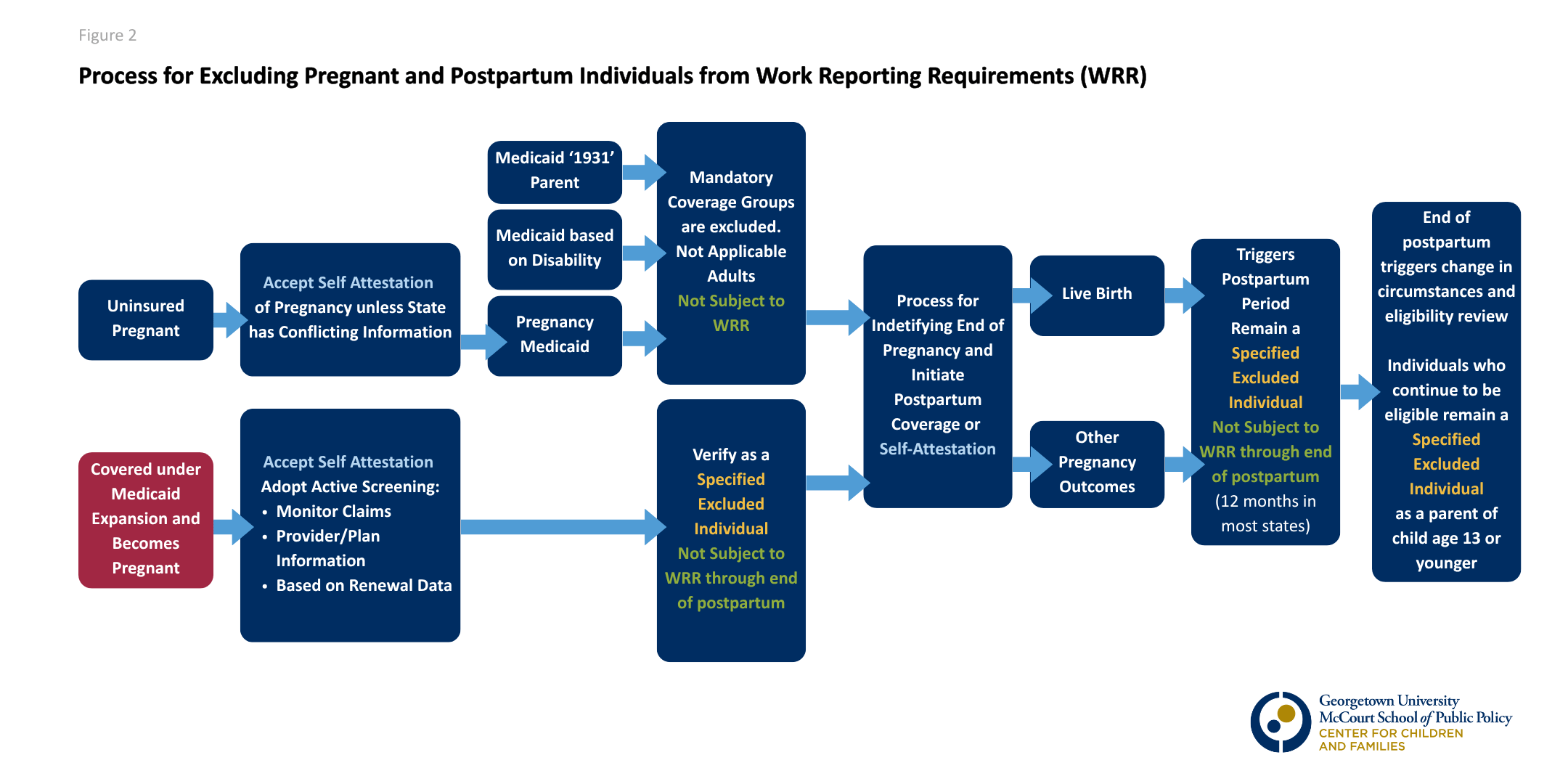
For starters, making exclusions work in practice is easier said than done, based on what we know from previous WRR attempts and the already-complex enrollment and eligibility process for pregnant and postpartum enrollees. The figure below shows the steps for enrollment among pregnant women. It also could be viewed from the perspective of identifying all of the potential places where pregnant women may fall through the cracks if the process isn’t clear to every system, navigator, eligibility worker and enrollee who is excluded from WRRs. Such clarity can only happen with dedicated state attention to keep pregnant and postpartum women covered.
Making matters worse, that state capacity is arguably at an all-time low, with states scrambling to stand up new WRR systems under extremely tight deadline pressure and grappling with shifting federal guidance amid growing cuts to federal Medicaid contributions. Hats off to states like Michigan. Full disclosure — I am married to a Michigander, I attended the University of Michigan for grad school and just enjoyed a family vacation in Michigan the last few weeks. During our cross-state adventure, I took a work day to attend the state’s annual Maternal Infant Health Summit in Saginaw, where I joined a panel with our friends at the Michigan Council for Maternal and Child Health and the Association of Maternal and Child Health Programs. All that to say, setting aside my bias and the state being top-of-mind, I remain impressed with how Michigan has responded so far to the challenges ahead.) Amid federal cuts, Michigan lawmakers passed a bipartisan budget that addresses H.R. 1 challenges while protecting access to health care and nutrition assistance for eligible Michiganders through Medicaid and SNAP. The budget also maintains support for initiatives like “Healthy Moms, Healthy Babies”, a program designed to address racial inequities in maternal and infant mortality. Even for states like Michigan, implementing H.R. 1 WRRs will be a heavy lift given the complicated federal regulations and tight timeline.
Which brings us to a related worry: A not-insignificant share of pregnant women are enrolled in Medicaid expansion – the very category targeted by WRRs. Analysis from our friends at the Urban Institute showed that while most pregnant women may be enrolled in the pregnancy or low-income parent categories (who should also be unequivocally excluded from WRRs by virtue of their enrollment category), 16% of pregnant women enrolled in Medicaid were in the expansion category in 2022. And as a reminder, for maternal and infant health, especially, expansion has been a game changer in the 41 states that adopted it. Medicaid expansion to low-income adults has been linked to better maternal and birth outcomes compared to those in non-expansion states. Likely because health coverage helps women are more likely to get chronic health needs addressed before they become pregnant, meaning fewer unaddressed complications to the pregnancy itself.
SO — for expansion enrollees who become pregnant—how will the state be able to exclude them from WRRs in a timely manner, ideally without requiring them to navigate red tape? We detail steps and ideas states should consider such as: “ex parte” use of electronic data, self-attestation, provider reporting to ensure pregnant enrollees maintain Medicaid coverage without interruption through their postpartum period.
Also, key to all of this is making sure Medicaid enrollees themselves understand where WRRs do and don’t apply to them. In Nebraska, where WRRs began July 1, First Five Nebraska has worked with partners to amplify public awareness by creating informational resources and videos targeted to pregnant women and parents, including links to state portals, contact information and resources.
Our new report also offers up questions state maternal and child health advocates, providers, community leaders and other stakeholders can ask their state Medicaid agencies to ensure for pregnant and postpartum enrollees are successfully excluded from WRRs as Congress intended. While states are making decisions on process and systems as we speak, the work is far from over – even after January 1, it will be pregnant women, their families, community leaders, health providers and others who can provide real-time feedback on how well exclusions work, or where improvements need to be made.
I hope our worries are overblown and every pregnant enrollee maintains uninterrupted Medicaid coverage throughout their pregnancy and postpartum period, and then receives easy WRR exclusion as a parent. If so, we can return to the equally necessary work to ensure Medicaid coverage meets its untapped potential to create equitable and optimal health outcomes for every pregnant woman.