Iowa
-
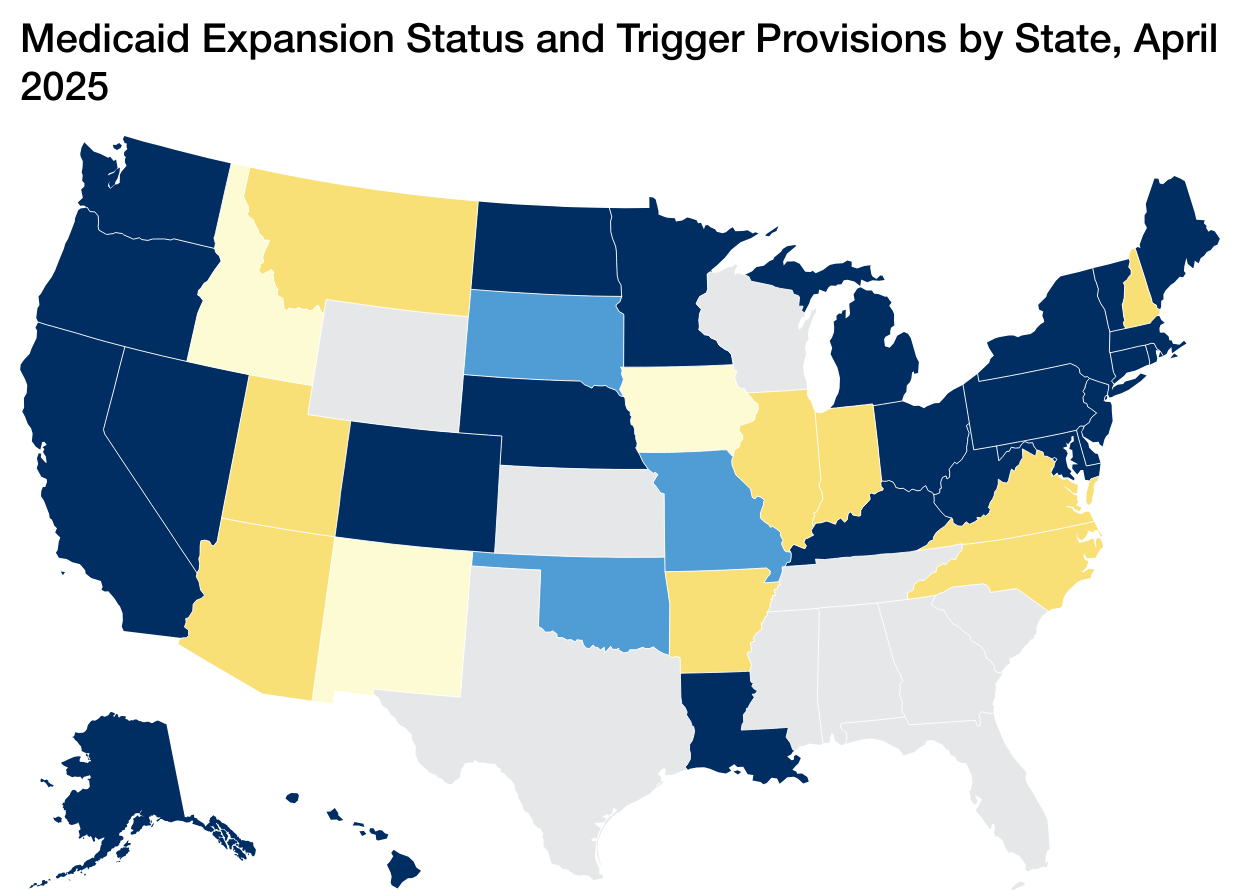
How Would Changes to Federal Medicaid Expansion Funding Impact People in “Trigger” States and Those with Expansion Enshrined in State Constitutions?
Congress is currently considering draconian cuts to Medicaid that would mean millions of low-income Americans lose access to affordable health care. But both the type of federal cuts and how the joint state-federal Medicaid program operates in each state mean that the impact on people living in different states would vary considerably. The major difference…
-
Medicaid’s Role in Small Towns and Rural Areas
Key Findings Background One-fifth of people in the United States live in areas that are classified as non-urban. Residents of rural areas and small towns face additional challenges accessing needed health services compared to residents of metro areas for a variety of reasons including acute provider shortages, limited connectivity, and long distances to travel to…
-
Federal Funding Cuts to Medicaid May Trigger Automatic Loss of Health Coverage for Millions of Residents of Certain States
Despite virtually no discussion of Medicaid during the election, Medicaid is facing proposals for significant reductions in federal funding. My colleague Edwin Park has already detailed some of the discussion around these cuts – which are being considered in service of facilitating an extension of tax breaks, the majority of which would go to the…
-
Postpartum Coverage and Benefits Key, But Merely the Start of Needed Medicaid Work to Address Maternal Health Crisis
Federal and state leaders have prioritized maternal health in Medicaid in recent years with welcome (if overdue) attention. As Say Ahhh! readers know, the new state option to extend postpartum coverage to 12 months for all pregnant women in Medicaid has been adopted or is in progress in all but two states (AR and WI)…
-
CMS Releases Updated Medicaid & CHIP Telehealth Toolkit, Includes State Best Practices and Behavioral Health Strategies
This month, CMS released an updated State Medicaid and CHIP Telehealth Toolkit consolidating information from previous toolkits and providing additional guidance – as required by the Bipartisan Safer Communities Act – on issues from billing best practices to strategies for using telehealth in schools. In addition to FAQs on issues such as benefit flexibility, financing,…
-
Medicaid Managed Care, Maternal Mortality Review Committees, and Maternal Health: A 12-State Scan
Download the Full Report Introduction The United States is in the midst of an ongoing maternal mortality crisis and Medicaid, the health insurer for low-income Americans, has an important role to play in addressing it. Medicaid is the nation’s single largest maternity care insurer, paying for more than 40% of all births on average across all states,…
-
State Medicaid and CHIP Snapshots, 2023
The Georgetown University Center for Children and Families (CCF) and the American Academy of Pediatrics (AAP) created factsheets underscoring the importance of Medicaid in providing coverage for children in all 50 states and the District of Columbia. Sources available here. Previous snapshots can be found here (2019), here (2018) and here (2017). Check out more interactive…
-
New Urban Institute Estimates of 1.7 Million More Uninsured Children if Supreme Court Overturns Affordable Care Act
On Tuesday, November 10, the Supreme Court will hear oral arguments for California v. Texas, a case in which a group of conservative attorneys general led by the Texas Attorney General and the Trump Administration are seeking to overturn the entire Affordable Care Act (ACA). Researchers from the Urban Institute recently projected that the number…
-
Iowa Families That Lose Health Insurance During Crisis Have Options
Public News Service Losing employer-provided health insurance is one of the side effects of the pandemic-driven economic crisis. That poses a big concern for Iowa families and their children, bit many do have options. It’s estimated that as many as 43 million Americans could lose their health insurance as a result of the pandemic… While…
-
Rate of Iowa Kids Lacking Health Insurance Inches Up
KMA Land – Iowa News Service By: Roz Brown The number of Iowa children without health care insurance is slowing inching up – a red flag, according to children’s advocates who track the impact on families… Joan Alker, executive director of the Georgetown University Center for Children and Families, says the trend of fewer children having…
-
2016 Maps
The interactive maps and data for 2016 provide information on the percent of adults and children covered by Medicaid and/or CHIP.You can embed these maps on your website by selecting a state on the left then copying the embed code on the right side of the map and pasting it into a post on your…
-
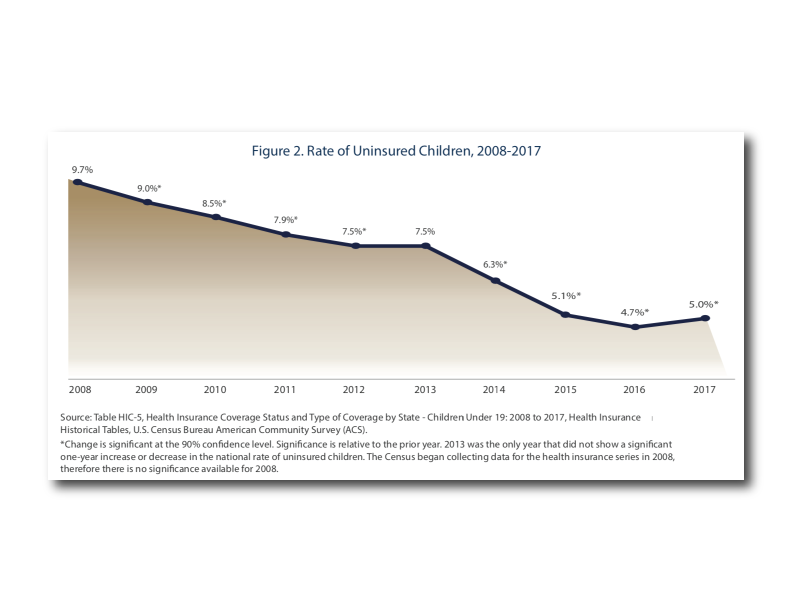
Nation’s Progress on Children’s Health Coverage Reverses Course
Introduction For the first time since comparable data was first collected in 2008, the nation’s steady progress in reducing the number of children without health insurance reversed course. The number of uninsured children under age 19 nationwide increased by an estimated 276,000 to about 3.9 million (3,925,000) in 2017, according to newly-available data from the…
-
Medicaid At Center Of Iowa Governor’s Race
Iowa Public Radio By: Katarina Sostaric Ads are flooding screens and mailboxes in Iowa calling the state’s move to privately-managed Medicaid a failure and a health care crisis. … The program start was delayed by federal regulators. Then complaints started mounting from patients who were denied services, and care providers who were taking financial hits…
-
Iowa’s Medicaid Expansion Benefits Small Town, Rural Residents
Public News Service By: Roz Brown Since Iowa expanded its Medicaid program in 2013, more low-income rural residents are covered by health insurance. A new report from Georgetown University shows that coverage gaps in states where Medicaid was expanded are much smaller than in states that did not expand. Anne Discher, executive director of the…
-
Dismissal of Co-Chair of Iowa Medicaid Advisory Panel is Setback for Much Needed Oversight
Medicaid is evolving. Its consumer advisory committees should too. State Medicaid programs are bureaucracies, and it’s understandable that agency leaders may not always have a pulse on what’s happening with members and providers and plans at any given moment. That’s why federal law has long required states to set up medical care advisory committees (MCACs),…
-
State Medicaid and CHIP Snapshots, 2018
The Georgetown University Center for Children and Families (CCF) and the American Academy of Pediatrics (AAP) created factsheets underscoring the importance of Medicaid in providing coverage for children in all 51 states (including the District of Columbia). Sources are available here. Previous snapshots can be found here.
-
Medicaid Proves to be a Winning Topic in this Year’s Pulitzer Prize Contest
Stories about Medicaid earned top honors in this year’s Pulitzer Prize contest: editorial writer Andie Dominick from the Des Moines Register earned a top prize for her columns on the consequences of Iowa’s transition to Medicaid managed care, and health journalist Andy Marso won a finalist mention for his coverage of the lack of transparency in…
-
Nationwide Rate of Uninsured Children Reaches Historic Low
Nationwide 95.5 percent of children had health insurance in 2016, up from 95.2 percent the previous year—and up from 92.9 percent in 2013, the year before the ACA was fully implemented. While relatively few children rely on the ACA’s Marketplace for insurance, many gained coverage in Medicaid or CHIP when their parents signed up for…
-
Section 1115 Medicaid Waiver Comments
Georgetown University’s Center for Children and Families contributes an independent perspective to the public dialogue on the future of Medicaid through the lens of children and their families.
-
State CHIP Snapshots
The Role of CHIP in Children’s Coverage In 2016 the children’s health insurance coverage rate in the United States dropped to just above 95 percent, an impressive achievement. Key to this success is the Children’s Health Insurance Program, which provides coverage to children who do not qualify for Medicaid but whose families cannot otherwise afford…